Entradas

Smart Skills Management software is helping manufacturers bridge the gap between training, skills, and work to build a more resilient and agile workforce.

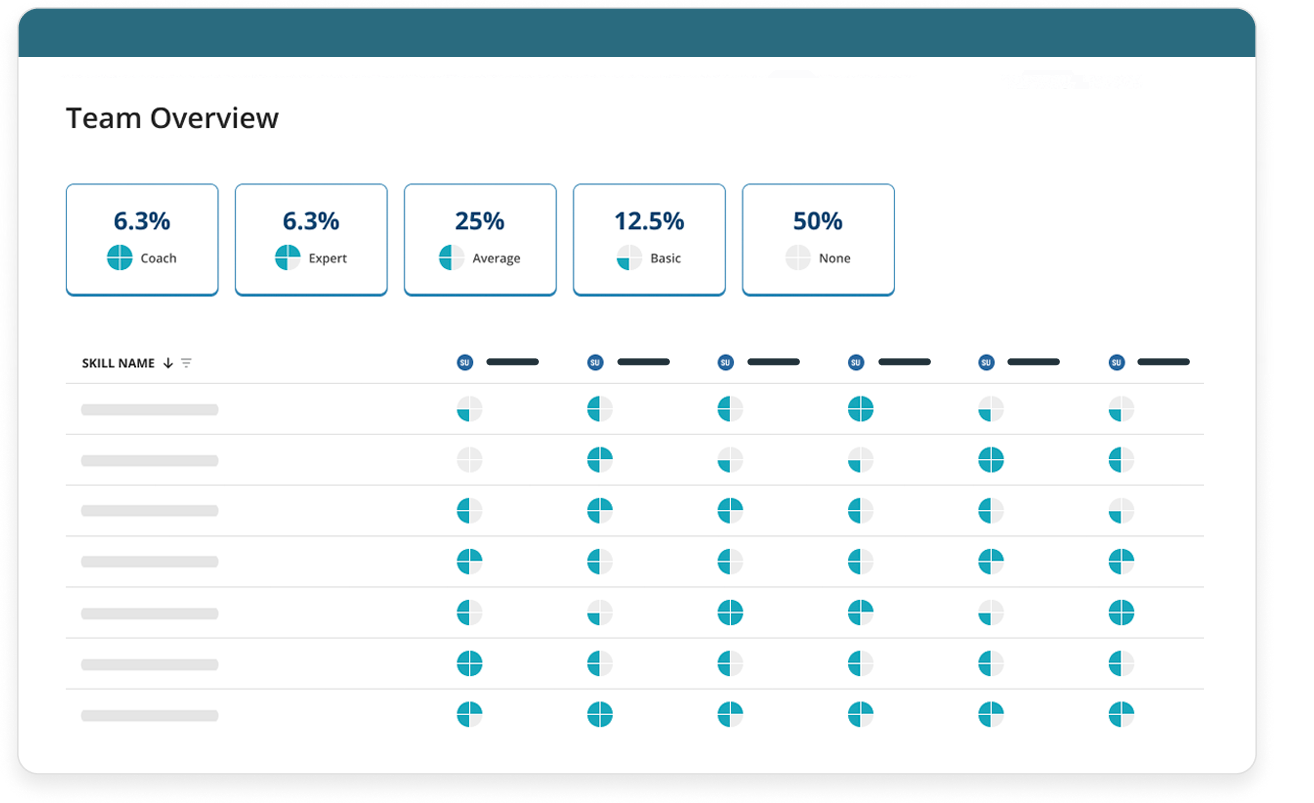
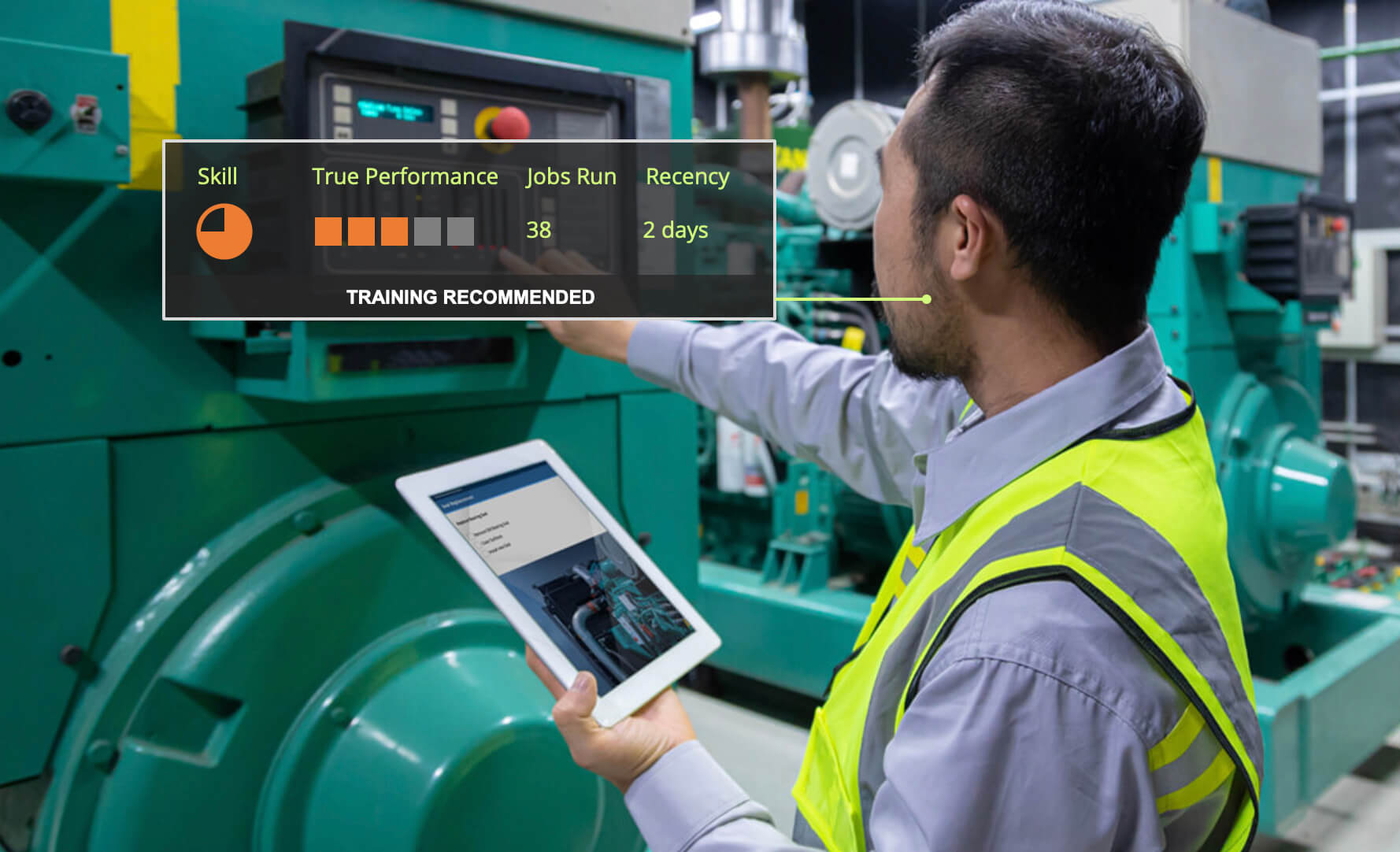
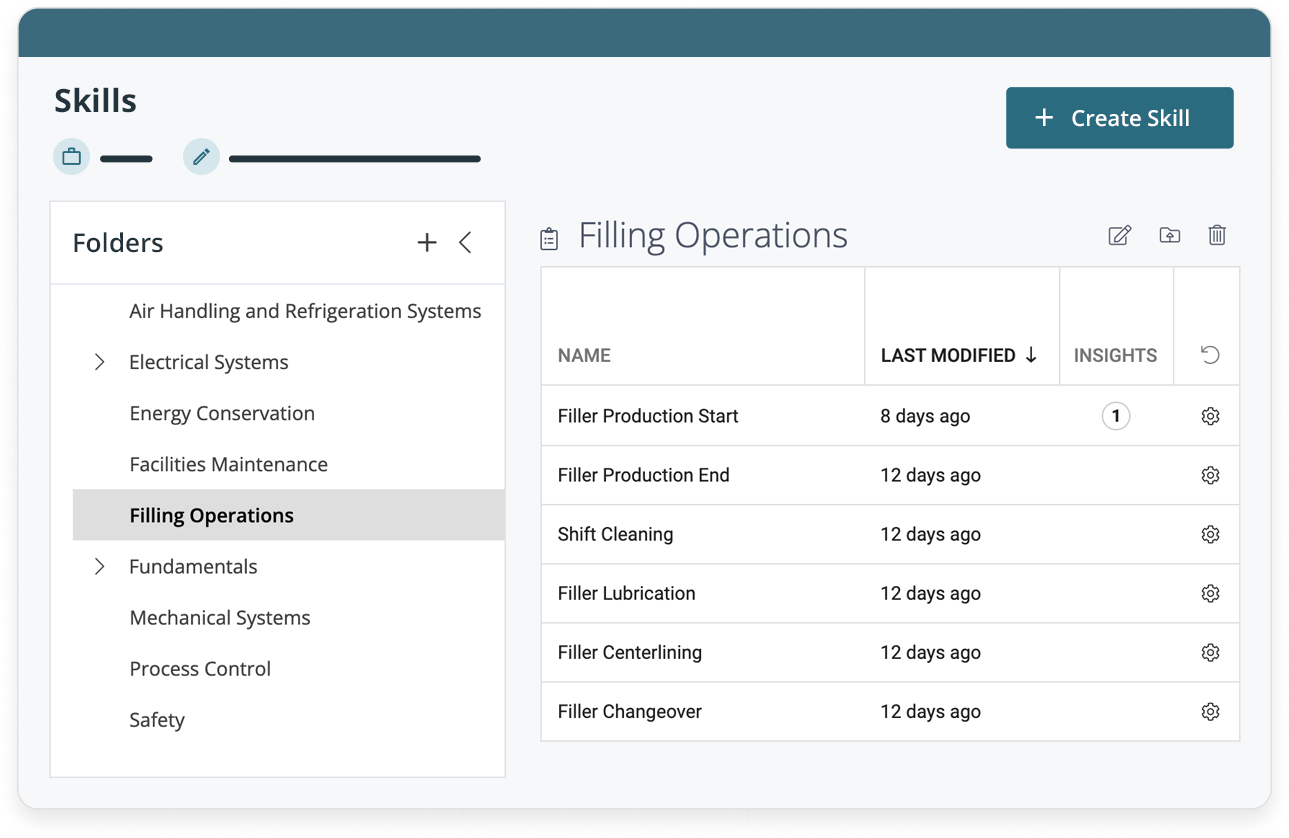
Skills management and tracking software helps manufacturers identify and track employee expertise. You can map skills from a centralized library to individual workers, analyze the performance of your teams, and fill any skill gaps that exist.

These smart insights can help businesses improve their talent management strategy, including training and development programs and recruiting opportunities.

If you’re interested in learning how to find the best skills tracking software, explore this article as we cover:

  • Benefits of skill management and tracking software
  • What to look for in tracking software
  • FAQs about skills tracking and management tools
  • Why Augmentir

Benefits of skills tracking and management software

Skills management involves identifying workers’ expertise and experience to determine whether they’re a right fit for a role, which areas need improvement, and how to best facilitate learning opportunities. A reliable skills tracking and management software solution lets you keep track of what your employees can and can’t do, and integrates that information with the actual work being done.

Here are a few reasons why you should invest in a tracking tool:

Enhanced training and development programs: Improve employee engagement by making sure courses and training opportunities are relevant to the jobs they perform. Management software makes it easier to assign employee courses that are appropriate and timely, and then track each individual’s training progress.

A more productive workforce: Employees who have access to training resources can further develop their skills to better perform assigned job duties and maximize output. This will empower workers to strive for continuous improvement and grow in their roles.

Improved retention: Offering continuous development and training programs can help your employees feel appreciated and taken care of. In return, they are more likely to stay and do a good job. Considering that turnover rates cost manufacturing firms an overwhelming amount, it’s critical to invest in programs that will improve retention rates.

What to look for in tracking software

Knowing how to effectively track employee skills can be challenging, but the right software can ease the burden. It makes it easier to identify who is lacking which skills and how to best close the gap.

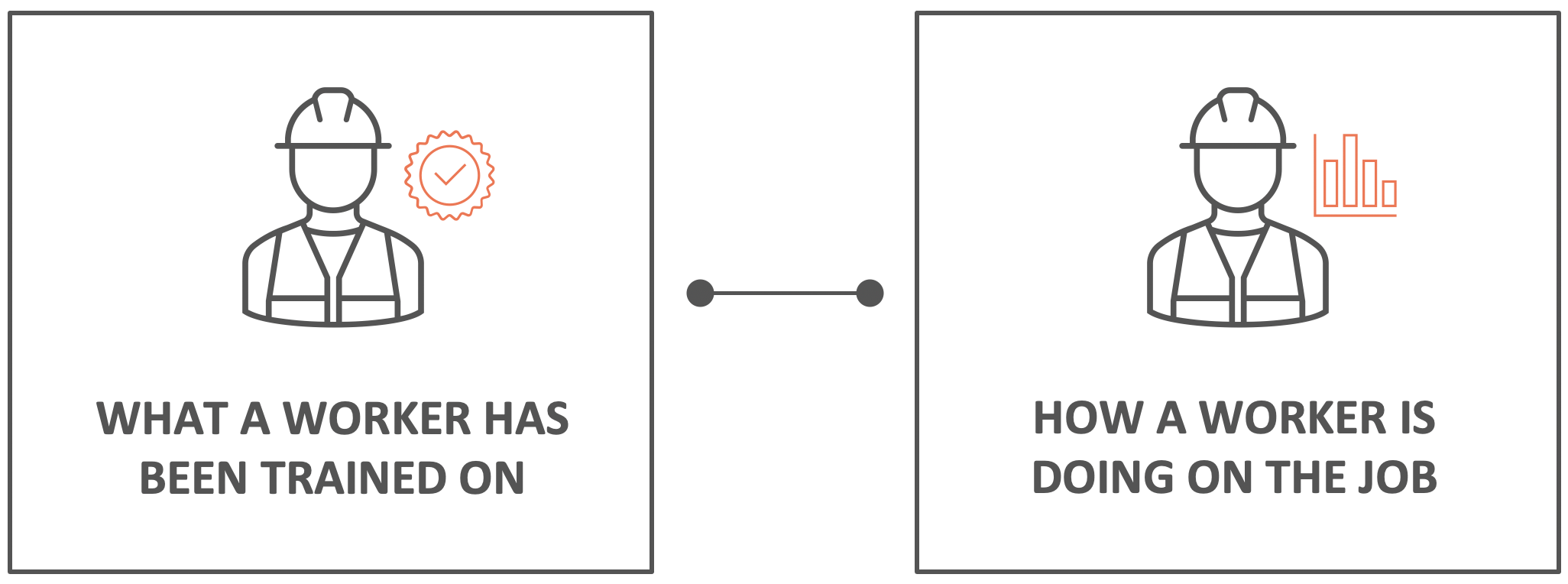
Unfortunately, standalone skills management software solutions that attempt to automate skills tracking fall short of meeting the needs of today’s manufacturers because they do not connect the “skills that workers know” with the “work being done”. These standalone skills management solutions may have been ideal for the stable, unchanging workforce of the past, but they are not suited for today’s era of high workforce variability.

Skills management solutions that combine skills tracking capabilities with connected worker technology and on-the-job digital guidance can deliver significant additional value. Data from actual work performance can inform workforce development investments allowing you to target your training, reskilling, and upskilling efforts where they have the largest impact.

When looking for the best skill management and tracking software, its critical to make sure it can:

  • Keep a centralized database of competencies
  • Pinpoint worker skill gaps
  • Let management look for employees with specific expertise
  • Track the skills of individual employees in a centralized database
  • Intelligently assign work based on true worker skills and competencies
  • Personalize on-the-job guidance based on worker skills and experience
  • Create reports or dashboards to study competencies and skill gaps across departments

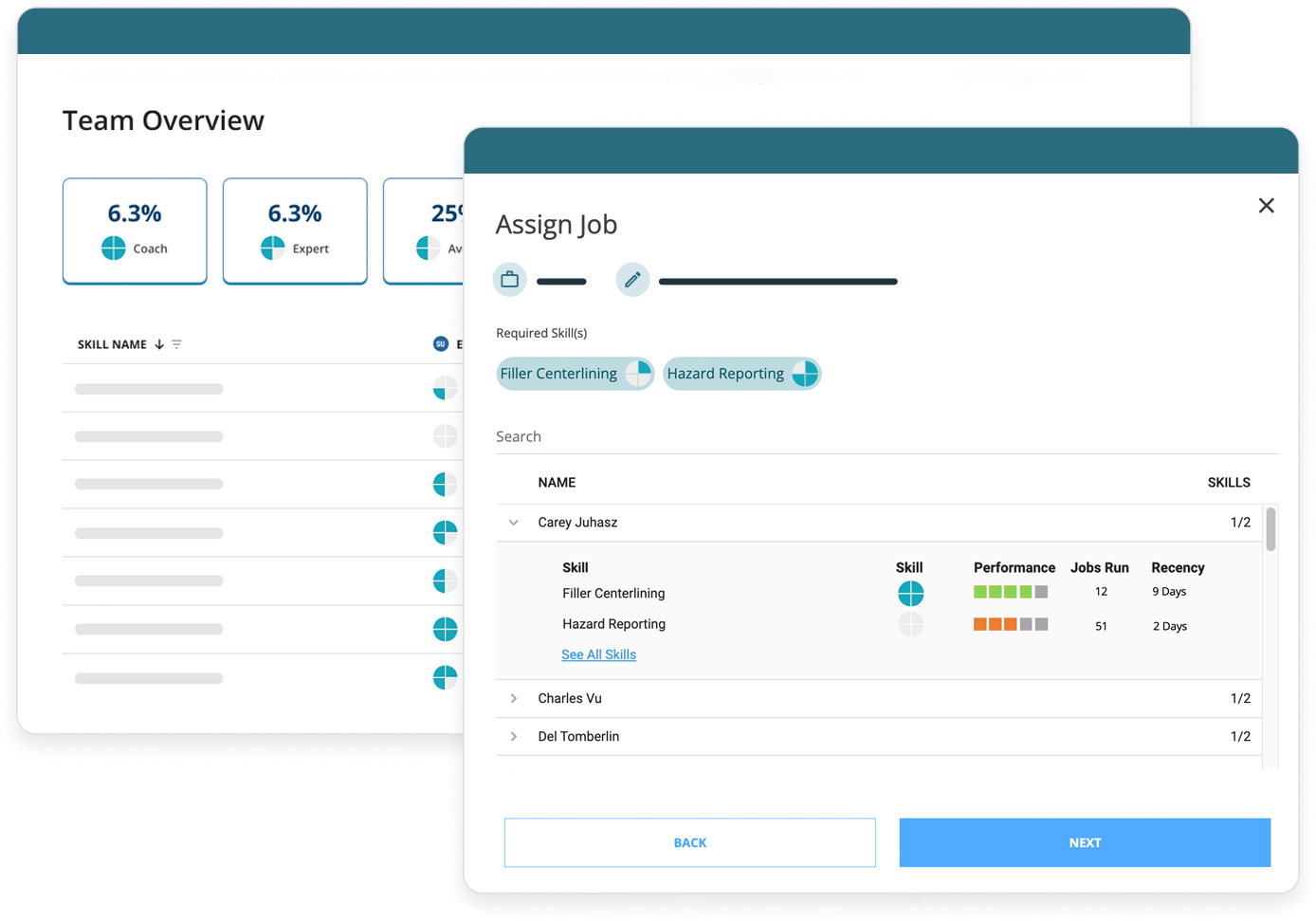
AI-powered software enables managers to filter through employee databases by skill to assemble teams best suited for a project.


software de seguimiento de habilidades


Skill management solutions should also integrate with core human resources software to offer seamless sharing of employee data. Some tools may even work in tandem with corporate learning management systems to provide access to educational content that could help workers develop new abilities.

Lastly, HR can use skill management software to make it easier to follow compliance regulations that require evidence of employee capabilities or certifications. For example, a health manufacturing facility may need workers to upload certain certifications to show proof of compliance.

FAQs about skills tracking and management tools

How do you keep track of employee skills?

You can track employee skills using software that manages worker competencies. These programs should allow you to build customized job profiles, create reports to study competencies, and fill skill gaps.

What is skills software?

Skills software is a tool that helps manage and keep track of worker expertise and experience. It’s used by businesses to optimize job performance and boost worker productivity.

Should I invest in skills tracking software?

Manufacturing facilities can benefit from investing in software that provides an easy-to-use centralized database of worker profiles, training resources, and much more.

Why Augmentir

Augmentir can help manage the skills of your workforce with its AI-powered connected worker solution. Our skills management tools create visibility at all times to optimize training programs, track individual and team progress, and initiate more targeted training. Check out our demostración en vivo.


Learn how Smart Skills Management software is helping manufacturers bridge the gap between training, skills, and work to build a more resilient and agile workforce.

Download our latest eBook – The Future of Work: Connecting Skills Management with Standard Work.


Augmentir’s take on the trending Workforce Institute’s staggering survey numbers.

Do you remember when offshoring–the outsourcing of production internationally–was once considered the “gold standard” for manufacturers because of reduced costs? Funny how things change. We can partly thank the global pandemic for this. Reshoring, also referred to as ‘onshoring’, in manufacturing is now the way to go–the apparent panacea to supply chain disruptions and a healthier economy. This should have manufacturers cheering and dancing in the streets, right? Not so fast. We’ve also got a massive labor shortage to deal with. But don’t fret. There are solutions to be found, and they happen to exist in software tools already being embraced by organizations on their journey to digital transformation.

The perks and pressures of onshoring in manufacturing

If your organization isn’t already thinking about onshoring its operations, maybe you should be. Onshoring in manufacturing means greater resiliency, agility, and sustainability by shortening the distances between process and delivery. Less travel means reduced emissions and adherence to ESG standards. Reshoring addresses issues associated with shipping costs, lead times, and new regulations. Working in familiar markets can help identify supply and demand trends more accurately. National employment rates are likely to increase when hiring residents and working with other domestic business partners.

But labor shortages and the variability of today’s workforce have not made reshoring an easy shift. So while there is tremendous opportunity to bring production home, the lack of affordable and skilled labor is having a tremendous impact on our domestic production capacity.

Here’s how you make onshoring work for you. First, stop thinking the old way of recruiting, training, and retaining workers will still work today.

Work with what you’ve got

What’s wrong with training today? Yes, training programs can help improve worker knowledge and skills development. But only if they are meeting the unique needs of individual workers with content-rich, high-impact learning and hands-on training programs. Forget those standard training programs–they are useless in the face of the variable workforce we have available today. The workers you can find are showing up with a mixed bag of experience and skills. That doesn’t have to be a disadvantage anymore. Because there is a smarter way to train and optimize the skills of each of those workers to meet productivity goals individually and fulfill the potential for your organization’s production capacity.

Smart digitization is the ticket to effective onboarding, training, and more–from hire to retire

“The secret of change is to focus all your energy not on fighting the old, but on building the new.” – Socrates

This new era of workforce instability is forcing manufacturers to change. It’s forcing them to turn to digital technology and look at smarter ways to hire, onboard, train, and retain their workers. At Augmentir, we call this Smart Digitization.

What do we mean by ‘smart’ digitization? Smart digitization involves adopting modern, digital tools, mobile technology, and supporting workers throughout their entire lifecycle.

smart digitization throughout worker lifecycle


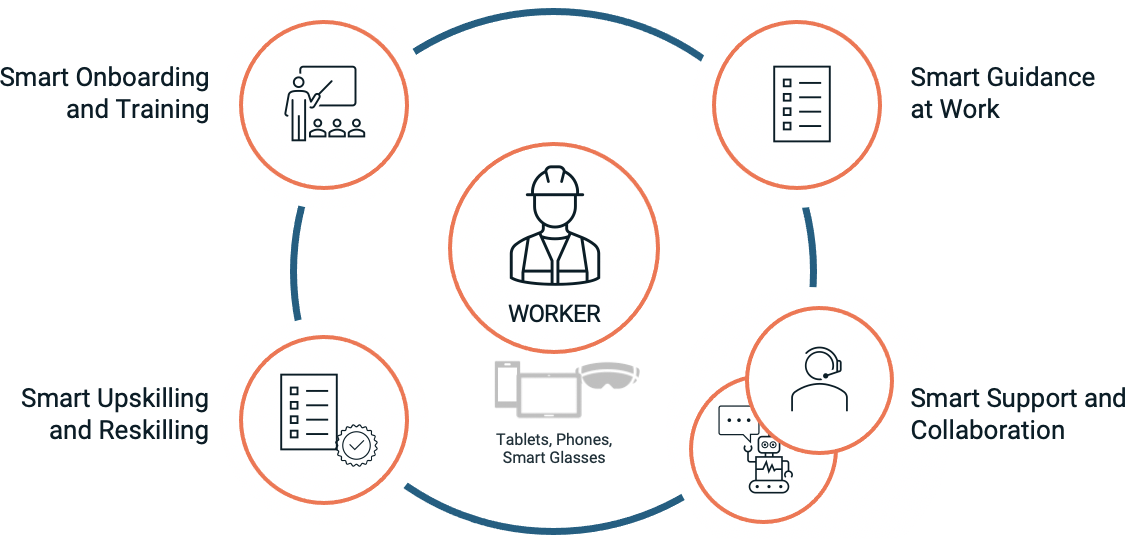
Modern connected worker tools are at the core of the solution that supports workers throughout their employment, from training to troubleshooting in real-time to ongoing learning and development. If you look at the entire employee lifecycle, this means:

  1. Using software tools to digitize and automate onboarding and skills tracking to help get workers operational faster, regardless of their skill and experience.
  2. Once on the job, digitizing and personalizing work instructions based on the individual needs of the worker – whether they are a novice worker or an expert.
  3. Proving instant access to support, within the flow of work.
  4. And finally, using an AI-based system to analyze how workers are performing on the job, and intelligently targeting upskilling and reskilling based on actual work performance.

Workers have access to a suite of digital tools and knowledge resources at their fingertips – digital work instructions, collaboration, and support tools to guide them on the job and quickly problem-solve complex tasks, allowing them to do their personal best.

For employers, this means not only more engaged and collaborative workers, it also means deeper insights into work performance that can help drive continuous improvement efforts.

Mapeo de competencias laborales y habilidades

AI-based smart insights intelligently optimize workers’ performance by identifying and tracking their skills in real-time. Smart insights pull from these performance metrics and learn to prompt workers who need new training programs or work opportunities, continuously upskilling and reskilling.

It’s the advanced medicine needed to maximize productivity and operational health.

So as you plan to bring more of your production back home, make sure you’re ready to seize the opportunity and address the challenges of a restricted labor market at the same time.


Find out how and why so many manufacturers are turning to Augmentir to turn their workers into efficient, productive, and long-term assets for their businesses.

Check out our latest webinar – Smart Digitization of Frontline Workers to learn more.


La inteligencia artificial y la tecnología de los trabajadores conectados están ayudando a los gerentes de primera línea a combatir el agotamiento de los empleados y mejorar el compromiso y la retención.

En la acelerada industria manufacturera actual, mantenerse a la vanguardia es fundamental para el éxito. Para seguir siendo competitivas, las empresas deben capacitar y mejorar continuamente a su fuerza laboral. Una forma de lograrlo es implementar la capacitación y acercarla a la planta de producción mediante inteligencia artificial (IA) y tecnología para trabajadores conectados. Implementar la capacitación implica adoptar un enfoque más sistemático para la capacitación y el desarrollo de la fuerza laboral, en lugar de tratarla como un evento puntual.

operacionalizar el aprendizaje

Según un Informe de McKinseyLas empresas que adoptan el aprendizaje impulsado por IA redujeron el tiempo de capacitación hasta en un 50% y mejoraron los resultados de aprendizaje hasta en un 60%.

Las soluciones basadas en IA hacen que el aprendizaje sea más accesible, atractivo y eficaz; y al integrar soluciones de formación y aprendizaje en las operaciones diarias de la empresa, los fabricantes pueden crear una cultura de aprendizaje y mejora continuos. De hecho, en Augmentir hemos visto a empresas manufactureras utilizar este enfoque para... reducir la incorporación de nuevos empleados y tiempo de entrenamiento hasta en 72%.

Aprendizaje: cuándo y dónde se necesita

La IA tiene el potencial de revolucionar muchas industrias, y la manufactura no es la excepción. Muchos trabajadores de la industria manufacturera trabajan en turnos, lo que les dificulta asistir a las sesiones de capacitación presenciales tradicionales.

Con la IA, las organizaciones pueden incorporar más procesos de aprendizaje en la jornada laboral diaria de sus trabajadores de primera línea, lo que permite, en esencia, operacionalizar la capacitación y reducir la brecha entre el conocimiento y la acción. Este "aprendizaje activo" se alinea con el modelo visual de la Pirámide del Aprendizaje, que ilustra las diferentes etapas del aprendizaje y su eficacia relativa.

pirámide del aprendizaje

El aprendizaje activo implica que el alumno participe activamente con el material, a menudo a través de la resolución de problemas, el debate o la aplicación del conocimiento mientras está en el trabajo.

En general, el aprendizaje activo (o aprendizaje del flujo de trabajo) se considera más eficaz que el aprendizaje pasivo para promover una comprensión profunda y la retención de información. Por lo tanto, los líderes de aprendizaje suelen esforzarse por diseñar experiencias de aprendizaje que impliquen niveles más altos de aprendizaje activo, superando los niveles inferiores de la pirámide y promoviendo el pensamiento crítico, la creatividad y la resolución de problemas.

Este enfoque se puede implementar con soluciones de aprendizaje móvil que aprovechan la tecnología de los trabajadores conectados y la IA para ofrecerles módulos de capacitación breves y a la carta, a los que pueden acceder desde sus teléfonos inteligentes o tabletas. Estos módulos se pueden personalizar según el nivel de habilidad de cada trabajador, lo que les facilita aprender a su propio ritmo.

Además, las soluciones de aprendizaje impulsadas por IA ofrecen:

  • Aprendizaje personalizadoLas soluciones de aprendizaje basadas en IA se pueden personalizar según el nivel de habilidad de cada trabajador, lo que facilita que aprendan no solo a su propio ritmo, sino también a su nivel de experiencia. Por ejemplo, a los trabajadores principiantes se les puede exigir que vean un microvideo de aprendizaje como requisito de seguridad para realizar una tarea, mientras que a un trabajador con mayor experiencia y competencia laboral adecuada podría no ser necesario.
  • Aprendizaje basado en el rendimientoLas soluciones basadas en IA ofrecen a los trabajadores experiencias de aprendizaje prácticas, personalizadas según su desempeño laboral. Estas experiencias pueden ofrecerse a través de diversos medios de contenido: multimedia, guías de autoayuda, vídeos de microaprendizaje e incluso experiencias de realidad aumentada (RA).
  • Retroalimentación en tiempo realLas soluciones impulsadas por IA pueden monitorear el desempeño de los trabajadores en tiempo real, brindando retroalimentación instantánea para ayudarlos a mejorar y brindar acceso a contenido para ayudar a resolver problemas en el flujo de trabajo.

La IA también puede ayudar a evaluar el desempeño de los empleados. Las evaluaciones de desempeño tradicionales suelen basarse en evaluaciones subjetivas de los gerentes. Por otro lado, las evaluaciones de desempeño impulsadas por IA pueden proporcionar una evaluación más objetiva y basada en datos del desempeño de los empleados, a la vez que ofrecen una visión más precisa de sus fortalezas y debilidades.

Mejor formación, mejor trabajo

Al implementar soluciones basadas en IA, las empresas pueden identificar y gestionar las necesidades de capacitación en toda la organización. Utilizando datos de rendimiento, la IA puede detectar deficiencias en el conocimiento o las habilidades de la plantilla, lo que permite desarrollar programas de capacitación específicos para subsanarlas.

Una vez implementada, la IA se puede utilizar para rastrear y mejorar eficazmente la efectividad del aprendizaje y la capacitación, aprovechando los datos sobre el desempeño de los trabajadores antes y después de la capacitación para medir el impacto y refinar los programas de capacitación para garantizar que brinden el mejor resultado.

A medida que la industria manufacturera continúa evolucionando, también debe evolucionar la forma en que abordan las soluciones de aprendizaje. Un estudio reciente... Encuesta de Deloitte Se descubrió que más del 90% de las empresas creen que el aprendizaje basado en IA será importante para el éxito de su organización en los próximos tres años. La IA tiene el potencial de operacionalizar la capacitación y transformar el aprendizaje en la industria manufacturera, acercándolo a la planta de producción. Al aprovechar el aprendizaje personalizado basado en IA, la retroalimentación en tiempo real, las evaluaciones de desempeño basadas en datos y la identificación de las necesidades de capacitación, las organizaciones industriales pueden crear una fuerza laboral más eficiente y eficaz.

Being thankful for AI might not seem like one of the usual items to include on your “What I’m Thankful For” list, but, AI truly has laid the foundation for not only the Augmentir platform, but for transforming the manufacturing workforce in positive ways

Every year as Thanksgiving approaches in the United States, we take time to reflect on what we are thankful for in our personal lives, such as family, friends, and health to name a few. As we started thinking about what we’re thankful for from a work perspective here at Augmentir, many things came to mind: our wonderful clients, an awesome team, our incredible founders, but one item high on our list is something that has allowed us to stand out in the Connected Worker platform space and make our product what it is today – Artificial Intelligence. Specifically AI in manufacturing. 

Being thankful for AI might not seem like one of the usual items to include on your “What I’m Thankful For” list, but, AI in manufacturing truly has laid the foundation for not only the Augmentir platform, but for transforming the workforce in positive ways as you’ll see below.

Improved Safety in the Workplace

One of the most common use cases for adopting AI has been in workplace screening and safety primarily as a result of the pandemic. Manufacturers found use in AI to monitor interactions of employees that needed to be in person on the shop floor during the pandemic so that they could conduct contact tracing and facility sanitization if necessary. Seeing the value of AI in workplace safety, manufacturers have continued to implement AI strategies for long-term solutions to identify safety events before they happen or to speed up post-incident root cause analysis for accidents like trips and falls. Industrial companies that implement AI-powered connected worker solutions as part of their digital transformation strategy have seen up to an 80% decrease in reportable injuries.

Connecting the Frontline Worker

According to Cisco, there are over 3 billion workers across the globe, and nearly two-thirds of these workers are frontline or field workers, whose day-to-day duties require that they physically show up to their jobs. Over the years, the manufacturing industry has done a really good job of connecting machines in the fabric of the business and giving operators the necessary data to help run those machines better. Our frontline workers are the least connected set of workers in the company. Frontline workers should be fully integrated into the fabric of the business from a collaboration standpoint so that they have access to the data that they need, when they need it. AI-powered connected worker tools provide not only a path to connect workers, but also intelligently deliver the right level of performance support so they can perform at their best.

Making Sense of Valuable Data

As workers become more connected, companies have access to a new rich source of activity, execution, and tribal data, and with proper AI tools can gain insights into areas where the largest improvement opportunities exist. Artificial Intelligence lays a data-driven foundation for continuous improvement in the areas of productivity, quality, and workforce development, setting the stage to address the needs of a constantly changing workforce. AI algorithms in manufacturing are ideal for analyzing large amounts of data collected from a connected workforce. AI can detect patterns, find outliers, cleanse data and find correlations and patterns that can be used to identify opportunities for improvement and create a data-driven environment that supports continuous learning and performance support. Using AI insights derived from Augmentir’s Connected Worker Platform, Colgate-Palmolive was able to save 10-30 minutes saved per shift and as much as 120 minutes reduced between Maintenance Notification and Maintenance Order Closure (Maintenance Execution Time).

Continuous Learning & Development

The new workforce dynamics and the nature of hybrid work are also now forcing manufacturers to re-think employee onboarding and training. The historic methods of onboarding and training taught workers everything they could “possibly” do which resulted in overtraining. The data-driven era we’re entering into is one of continuous learning and development powered by AI. Training shifts from the things frontline workers are possibly going to do to what they are probably going to do. Implementing AI in manufacturing training results in reduced training times, continuous learning and development, and the ability to upskill at any point as needed. Learning is always available, training content is available on-demand to the worker on the shop floor at the time of need. Reducing the initial onboarding training and allowing training to occur at the moment of need, coupled with AI for scoring, provides insights into the most effective training modules as well as what needs to improve based on demonstrated execution.


At Augmentir we believe that the purpose of a Connected Worker platform isn’t simply to deliver digital work instructions and remote support to a frontline worker, but rather to continually optimize the performance of the connected worker ecosystem. AI is uniquely able to address the fundamental macrotrends of skills variability and the loss of tribal knowledge in the workforce. With an ecosystem of content authors, frontline workers, subject matter experts, operations managers, continuous improvement engineers, and quality specialists, there are dozens of opportunities to improve performance – and that’s something to be thankful for.


To learn more about how AI is being used to digitize and modernize manufacturing operations, check out our latest eBook – Construya una fuerza laboral moderna y conectada con IA.

Conozca qué es una matriz de habilidades, cómo se pueden utilizar y alternativas para ayudar a realizar un seguimiento de las habilidades de los empleados.

Una matriz de habilidades es una cuadrícula que representa las habilidades y cualificaciones de los empleados. Las empresas utilizan esta información para gestionar, planificar y supervisar las habilidades actuales y deseadas para un puesto, equipo, departamento o proyecto.

Tener un lugar para registrar las habilidades y el nivel de experiencia de cada empleado puede ayudar a los gerentes a decidir cómo distribuir las tareas. También es una excelente manera de evaluar las áreas de mejora.

Una matriz de habilidades suele gestionarse mediante una hoja de cálculo, pero existen alternativas. Por ejemplo, el software de gestión de habilidades en la nube puede ayudar a identificar y monitorizar las competencias de los empleados y correlacionarlas con su desempeño laboral real. El software también puede ayudar a los gerentes a filtrar las bases de datos de empleados por habilidades para formar equipos o asignar tareas según cualificaciones específicas.

matriz de habilidades

Para ayudarle a aprender más sobre la matriz de habilidades y su alternativa, este artículo explora los siguientes temas:

¿Qué es una matriz de habilidades?

Una matriz de competencias es una herramienta que utilizan los empleadores para registrar las habilidades y la experiencia de los trabajadores. Generalmente, se mantiene en formato de hoja de cálculo e incluye las habilidades que los trabajadores ya poseen, las necesarias pero poco desarrolladas, y las requeridas para completar un proyecto o desempeñar una función laboral.

Cada empleado recibe una calificación según su dominio de cada habilidad y su interés en desarrollarla. Esto proporciona a los gerentes una visión clara de quién está cualificado para realizar determinadas tareas.

¿Cuáles son los beneficios de utilizar una matriz para realizar el seguimiento de las habilidades de los empleados?

Una matriz de habilidades ofrece múltiples beneficios que pueden aumentar el rendimiento del equipo y la productividad. Algunos de sus beneficios incluyen:

1) Concientiza sobre las habilidades de los empleados.

Esta herramienta muestra en qué área destaca un miembro del equipo y dónde puede mejorar. Esto permite identificar qué habilidades deben cultivarse y en qué áreas ya dominan los miembros del equipo.

2) Establece expectativas del equipo

Con la matriz que describe qué habilidades se necesitan para completar un proyecto, los empleados tienen una mejor idea de lo que se espera y se requiere para ser competentes en sus funciones.

3) Muestra dónde se necesitan nuevas contrataciones

La matriz permite a los empleadores comprender mejor si es necesario contratar a alguien para un puesto determinado. Conocer las habilidades que faltan ayuda a los gerentes a determinar qué tipo de empleado se necesita contratar para un proyecto específico.

¿Cómo creo una matriz de habilidades?

Crear una matriz de habilidades puede aportar numerosos beneficios a una empresa. Puede configurarla siguiendo estos pasos:

  1. Determine qué habilidades son necesarias para su equipo según la función o responsabilidad del trabajo.
  2. Evalúe las habilidades y cualificaciones de sus trabajadores.
  3. Cree un sistema de calificación para evaluar el nivel de habilidades actual de cada empleado.
  4. Complete los criterios que faltan y gestione la información en un sistema central de gestión de habilidades.

Matriz de habilidades para la gestión de habilidades

¿Cómo se pueden utilizar las matrices de habilidades en la industria manufacturera?

La industria manufacturera busca constantemente empleados cualificados. Las matrices de cualificación son una excelente manera de desarrollar las habilidades de los trabajadores de las plantas de producción y aumentar la productividad.

Esta herramienta organizativa también simplifica el proceso de contratación. Por ejemplo, permite a los gerentes comprender mejor qué habilidades faltan y quién podría ser el candidato ideal para el puesto.

Cuanto mejor preparado esté un empleado para realizar su trabajo, mejores serán los resultados de la empresa.

¿Cuáles son las alternativas al uso de una hoja de cálculo para su matriz de habilidades y competencias?

Si busca una alternativa a usar una hoja de cálculo para gestionar las habilidades de su equipo, considere un software de gestión de habilidades basado en la nube. Estos programas ayudan a las empresas a identificar y monitorear las competencias de sus empleados.

Por ejemplo, este software asigna habilidades de una biblioteca centralizada a perfiles de puestos y empleados individuales para ayudar a los gerentes a analizar las capacidades de sus equipos, las habilidades deseadas para cada puesto y las carencias de habilidades existentes. Más información sobre software de gestión de habilidades en nuestra guía.

Además, el software de gestión de habilidades no solo le permite gestionar de manera eficiente las habilidades de sus trabajadores de primera línea, sino que también le permite utilizar este mapeo de habilidades para asignar trabajo de manera inteligente o identificar necesidades de mejora o reciclaje de habilidades.
Mapeo de competencias laborales y habilidades


¿Le interesa saber cómo la plataforma de trabajadores conectados de Augmentir puede ayudarle a digitalizar y gestionar eficazmente las habilidades en su planta de fabricación? Contáctenos para una demostración gratuita.


Learn about the best practices for optimal asset maintenance performance and how to track your assets to ensure that everything is in working condition.

Asset maintenance refers to everything that goes into keeping your manufacturing assets in tip-top shape. With machinery, for example, asset maintenance means conducting frequent inspections and repairs. With office space, this term involves maintaining a clean, safe, and productive workplace. With products, it includes checking finished goods for any deficiencies or errors.

In a nutshell, asset maintenance helps prolong the performance and lifespan of equipment, machinery, goods, and more. Performing this strategy ensures that your essential business resources continue functioning smoothly and properly.

Learn the best practices for increasing asset maintenance performance:

Best practices for optimal asset maintenance performance

Implementing key best practices can improve asset maintenance in manufacturing. We’ve put together five crucial strategies to ensure your manufacturing firm is performing at its best while minimizing costs:

1. Gather as much info as possible

Gathering data on assets can help management make better informed production decisions. Asset tracking is a great technique to accomplish this.

2. Create a preventive maintenance schedule

The data that’s been collected will make it easier to create a preventive maintenance schedule. To create one, start by organizing asset data and analyzing the info you’ve amassed (e.g., how often each item must be checked and maintained). Lastly, prioritize your most important assets and allocate funds to maintain them.

schedule and audit asset maintenance work

3. Train workers

Investing in your employees pays off. Procedural documentation and training will help ensure that all maintenance work is thoroughly performed and recorded. Skills management software can help with ongoing management and tracking of employee skills and training requirements.

4. Apply an inventory tracking system

There is nothing worse than beginning a project only to find out that you don’t have all the moving parts to complete it. An inventory system helps reduce the chances of missing crucial product information and enables you to better track company assets.

5. Track asset maintenance key performance indicators (KPIs)

KPIs such as mean time between failures (MTBF), overall equipment effectiveness (OEE), and work order resolution time can give a performance review on how well your assets are doing. They’re also great at pinpointing which areas could benefit from predictive maintenance, the process of checking for deficiencies to avoid future machine breakdowns.

Consejo profesional

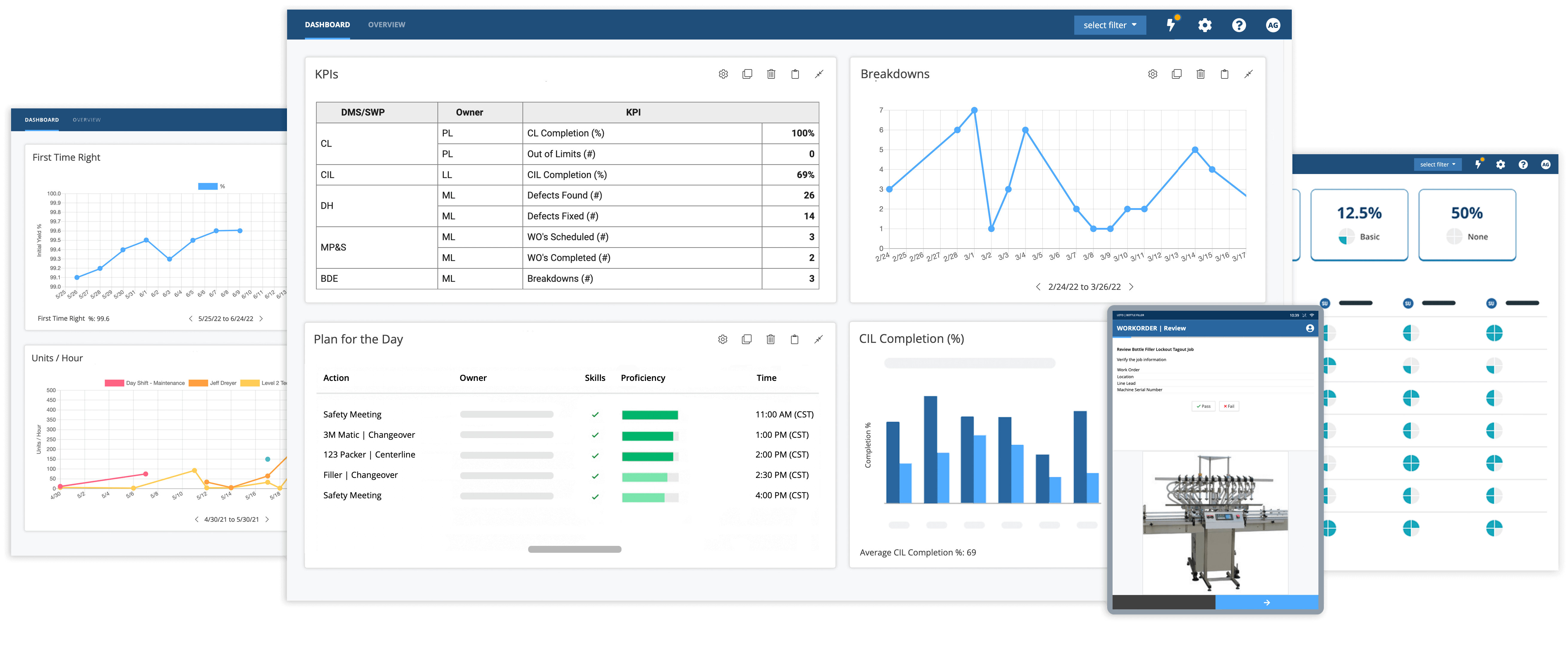
Asset management software like Augmentir’s Connected Worker Solution helps you simplify the operations and maintenance of your facility. Manage work and maintenance procedures, skill requirements, training, KPIs, and preventive maintenance schedules all through a visual interface. Connected worker solutions help integrate your CMMS with your shop floor operations.

A

Advantages of asset maintenance

The maintenance of assets in manufacturing consists of regularly inspecting, repairing, and replacing equipment and other assets to confirm that everything is in workable condition.

Advantages of asset maintenance:

  • Enhanced workplace safety
  • Greater equipment reliability
  • Longer machine lifespan
  • Costos de mantenimiento más bajos
  • Improved productivity
  • Better regulatory compliance

Asset maintenance tools and how Augmentir can help

Manufacturers are encouraged to manage and track assets to limit product flaws, prevent machine failure, and improve overall productivity. However, in today’s digital age, especially with more mobile devices, complex cloud-based technologies, and software updates, handling assets has become much more complicated.

This is where Augmentir’s AI-powered solución de trabajador conectado, or asset management software, comes in. Our solution allows manufacturing facilities to better monitor their assets and manage them effectively with easy-to-use customizable dashboards and real-time insights.

Asset maintenance with Augmentir

Ours is the world’s only connected worker suite that provides an overarching view of an asset’s life cycle. Accurate digital asset records can help manufacturers with resource planning. In addition, our tool helps with asset record keeping so that you don’t have to worry about not meeting regulatory compliance requirements.

Though a manufacturing firm could use a spreadsheet to track its assets, our digital solution gives workers the ability to evaluate asset-specific data and make better decisions about how to manage each one.

Transform how your company runs its maintenance operations. Request a live demo today!


Vea Augmentir en acción
Contáctenos para una demostración personalizada

La tecnología impulsada por IA puede ser la pieza faltante del rompecabezas para la crisis laboral actual.

Are you still printing work instructions and operating manuals? If so, we need to have a serious chat! Maybe you invested in “going digital” a while back and think your work is done. You’re not alone. It was considered “groundbreaking” when PDF files made their way to the factory floor. 

The first generation of digital work instructions were birthed after learning 46 percent of field technicians claimed paperwork and administrative tasks were the worst part of their day-to-day job. No argument here. Completing and filing paperwork is time-consuming and there is potential for lost information. There was an obvious upside to going digital, except for no longer being able to tell your supervisor that your dog ate your worker performance report. 

But even now that technology is ready for the archives. An estimated $1.3 trillion (and counting!) has been spent on digital transformation initiatives as the online connected workplace and market continue to move at a rapid pace. 

We are no fortune tellers, but studies show that 25 to 31 percent of 3.3. million business service jobs will be automated in the next decade. This doesn’t mean everyone is being replaced by robots. On the contrary. It means technology is improving to help workers do their jobs even better. Manufacturing companies need to be prepared to hop on this next-generation train if they aren’t already.

Move over one-size-fits-all training and work instructions 

The individualized, real-time, connected worker platform is here. Let us emphasize individualized. Connected worker platforms are being implemented in myriad industries, from automotive to food processing. Any industry which is adapting daily to the constant shifts and pressures of the global economy. Regardless of the industry, standard digital work instructions are no longer effective. They do not reflect the real-time changes happening in the operation, such as order fulfilment and materials inventory, or equipment maintenance needs and the capabilities of the workers operating the machines. Imagine working on the manufacturing floor for five years and handed with the same instrucciones de trabajo estandarizadas as the new hire.

Does this make sense? Not anymore. Not when AI-based technology is changing what’s possible. And what’s different about this latest wave of technology that makes it so special? It’s built around optimizing the performance of people (Gasp.)

Change is inevitable. Growth is optional. – John C. Maxwell

A marriage made in heaven–the next generation of workers is ready for a digitally connected workplace

Recruiting and retaining talented workers is one of the greatest challenges facing operations today. We get it. But there’s good news. As one generation of workers readies for retirement, another is stepping up to fill the gap. Gen Z is overflowing with talented innovators in the tech world having grown up surrounded by non-stop advancements and devices. Need one of them to look somebody up in the phone book? Forget it. But need assistance when your home computer suddenly “dies”? These are your people. 

It’s more than video games. Their education has been largely based on a digital foundation. Nearly every function of their daily lives has an element of connectivity to the broader online world. You could say this generation is hardwired to respond best to customized digital learning platforms. It’s their love language. And so the potential to drastically improve productivity is real.

The beauty of the digitally connected worker–could they be “the One”?

The digitally connected worker has all the right stuff for a long-lasting relationship with your operation. The digital training and work instruction platform holds their unique inventory of skills, goals, and performance history, and works with them to become a better version of themselves on the floor. Workers whose individual needs are supported are better, more engaged employees. They have the self-confidence – as well as the tools and specific instructions – to address problems head on when they arise. An investment in AI-powered technology is an investment in a stable, adaptable, and reliable workforce.

Are you and your workforce ready to take this next step in digitization? Contact Augmentir to start the conversation. Together let’s step into the full potential that this generation has to offer to improve your operational efficiency.

Today’s industrial workforce is changing in real-time – who shows up, what their skills are, what jobs they need to do, is a constantly moving target. The traditional “one size fits all” approach to training, guidance, and performance support is fundamentally incapable of enabling today’s workers to function at their individual peak of safety, quality […]

Today’s industrial workforce is changing in real-time – who shows up, what their skills are, what jobs they need to do, is a constantly moving target. The traditional “one size fits all” approach to training, guidance, and performance support is fundamentally incapable of enabling today’s workers to function at their individual peak of safety, quality and productivity.

Watch the recording of our recent virtual roundtable of industry leaders as they discussed proven approaches to delivering performance support and modern training approaches for today’s industrial workforce.