Entradas

Say hello to the newest addition to the Augmentir platform, Augie – the GenAI powered digital assistant for manufacturing.

Say hello to the future of work in manufacturing with the latest addition to Augmentir’s suite of connected worker tools, Augie™.

augie generative ai assistant for manufacturing

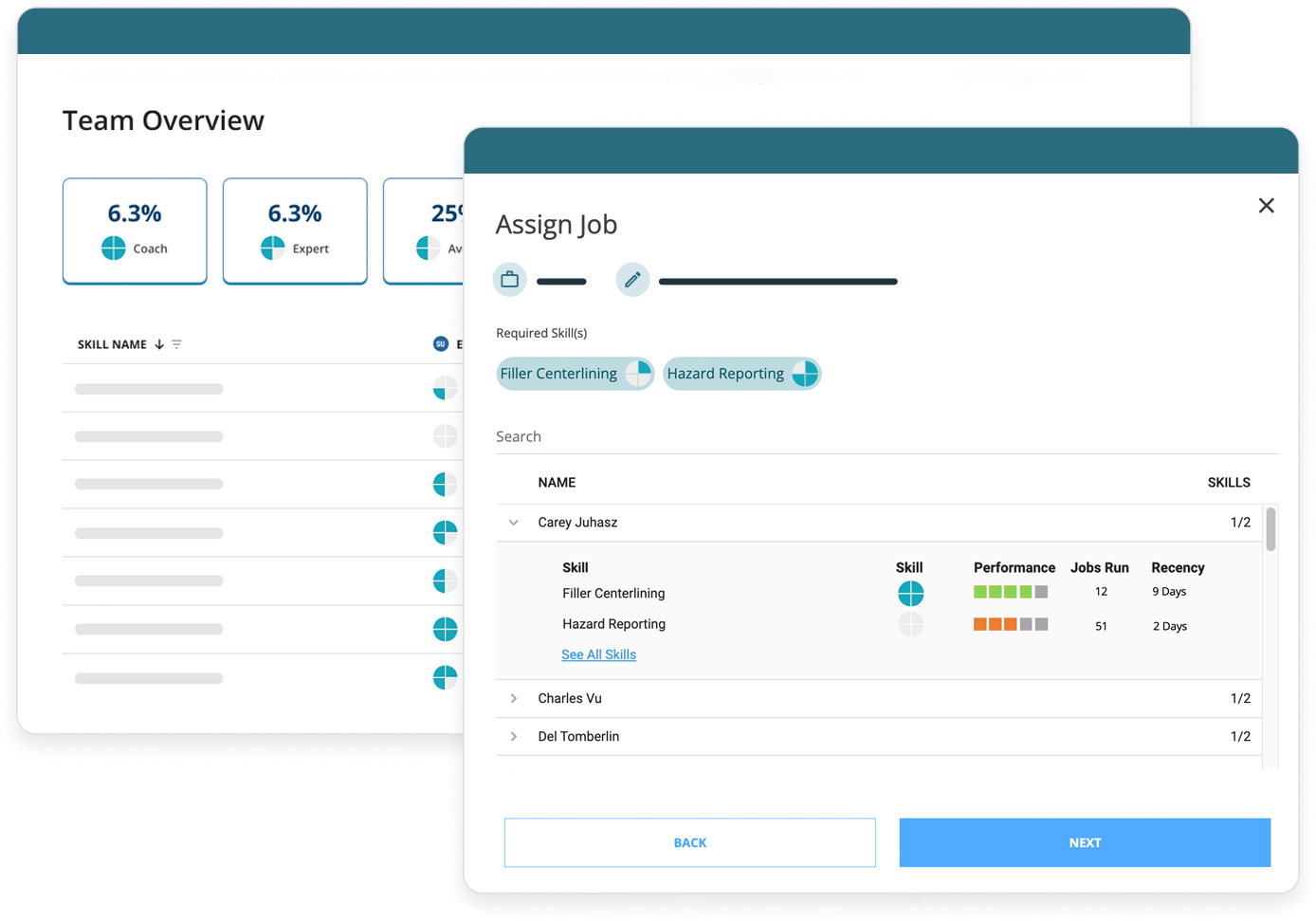
Augie is a digital assistant for frontline operations that utilizes Generative AI and proprietary fit-for-purpose, pre-trained Large Language Models (LLMs) to enhance operational efficiency, problem-solving, and decision-making for today’s less experienced frontline industrial workers. It leverages enterprise-wide data, provides instant access to relevant information, closes skills gaps with personalized support, offers insights into standard work and skills inventory, and identifies opportunities for continuous improvement.

Augie is a result of our dedication to empowering frontline workers, leveraging AI to support manufacturing operations, and giving manufacturing workers better tools to do their jobs safely and more efficiently.

Continue reading below to learn more about how Augie works and how it can benefit your frontline workforce and manufacturing operations:

How our GenAI Powered Assistant Works

Generative AI-powered smart manufacturing assistants are designed to provide secure, role-based, personalized assistance to frontline workers, engineers, and managers in various industries, including manufacturing.

Funcionan aprovechando la inteligencia artificial y las integraciones en diferentes sistemas de software, proporcionando orientación y asistencia en diversas tareas para mejorar la productividad y el rendimiento. Esto incluye información sobre datos, recomendaciones sobre acciones para mejorar el rendimiento y la capacidad de crear análisis y paneles de control con un asistente basado en lenguaje natural.

A majority of fabricación inteligente assistants only draw their information from manufacturing execution systems (MES), without tying in other important systems necessary for frontline manufacturing success.

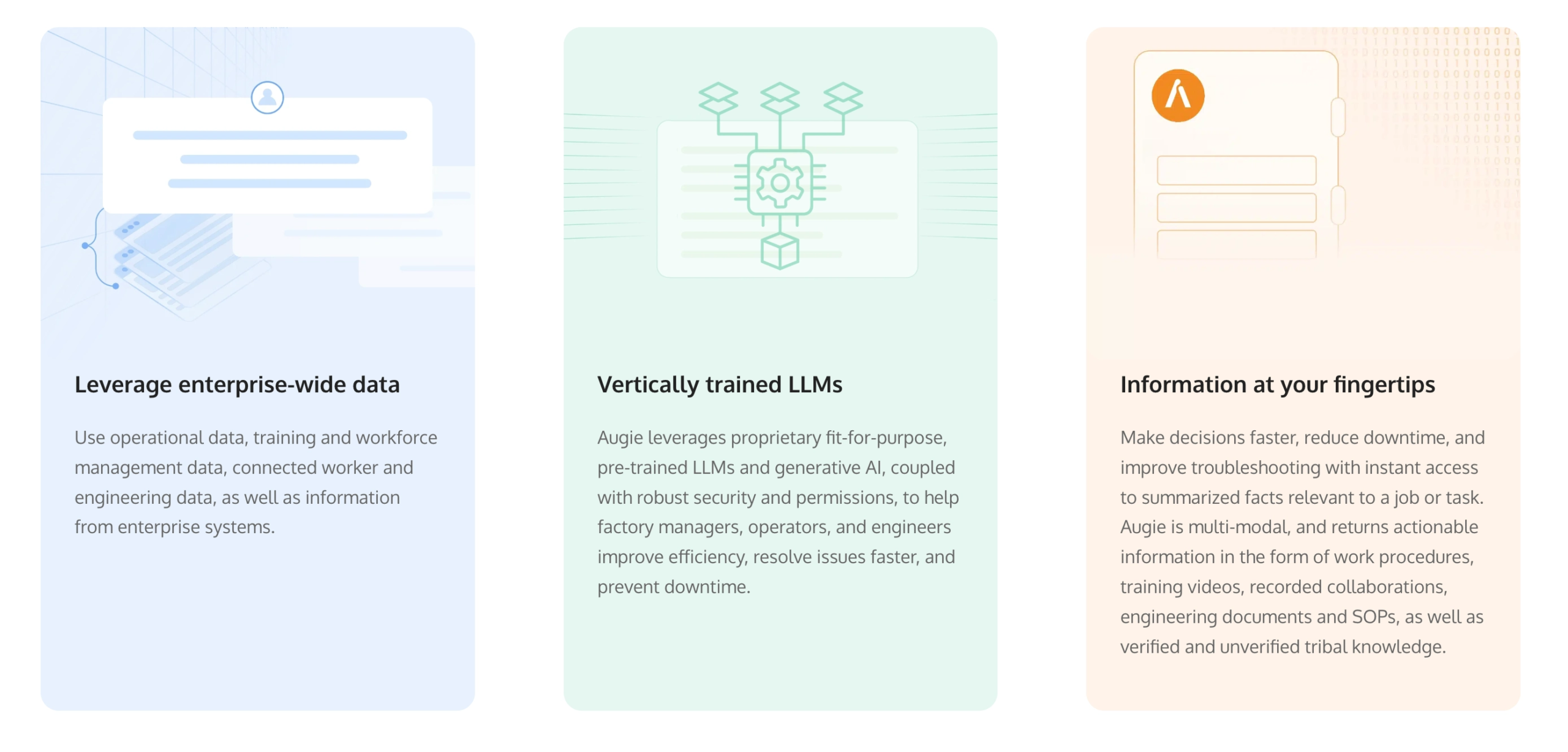
Augie, however, is different. It leverages enterprise-wide data tying in information from a wide range of platforms including operational data, training and workforce management data, connected worker and engineering data, as well as information from enterprise systems.

gen ai industrial manufacturing

How Augie Benefits Your Frontline Workforce

Augie is unique among other smart manufacturing assistants. It leverages proprietary fit-for-purpose, pre-trained LLMs and generative AI, coupled with robust security and permissions, to help factory managers, operators, and engineers improve efficiency, resolve issues faster, and prevent downtime.

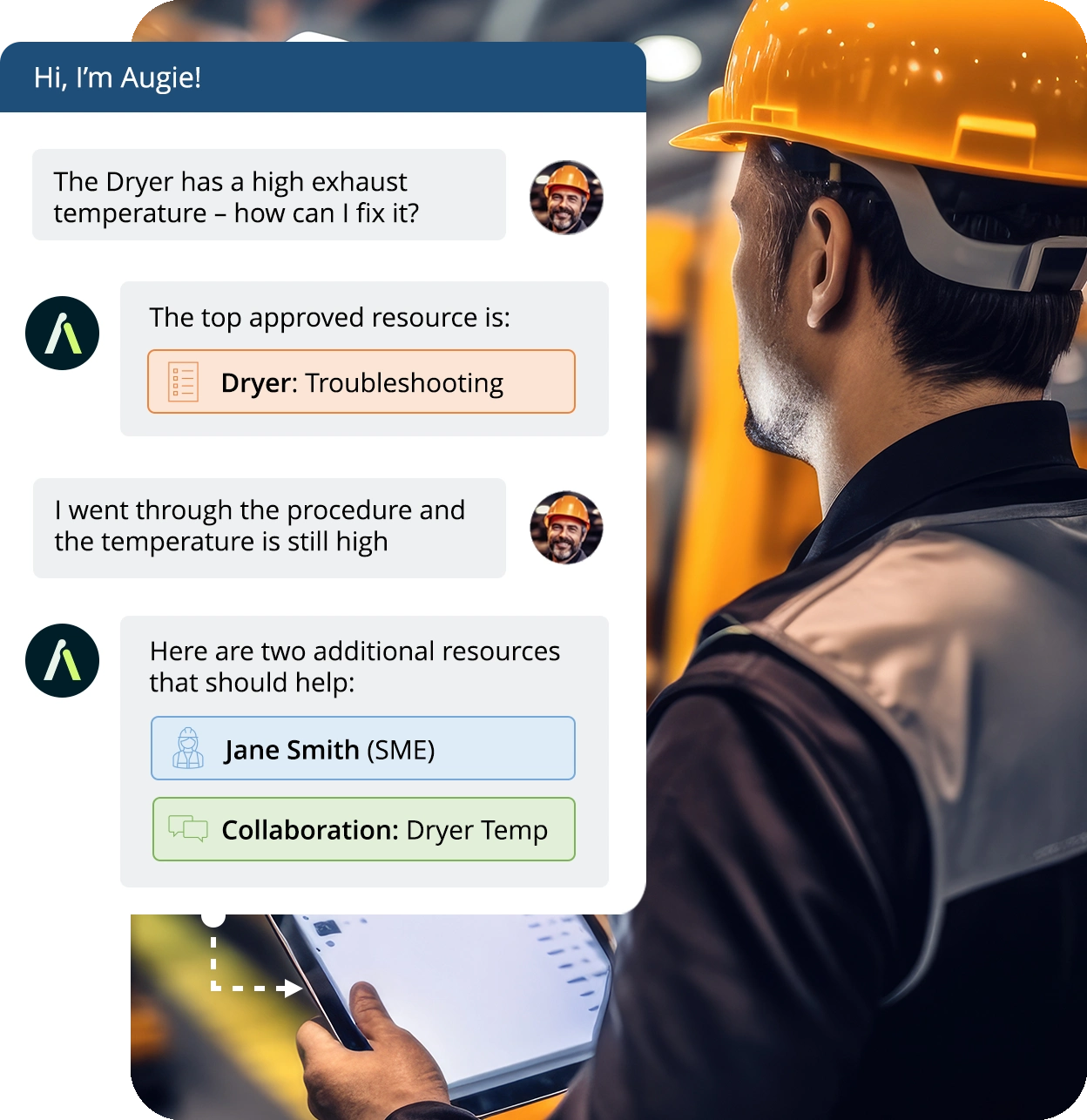
With information readily available via Augie, frontline workers can make decisions faster, reduce downtime, and improve troubleshooting with instant access to summarized facts relevant to a job or task. Additionally, Augie is multi-modal, meaning it can return actionable information in the form of work procedures, training videos, recorded collaborations, engineering documents and SOPs, as well as tribal knowledge.

Through Augie, manufacturers can instantly:

  • Close skills and experience gaps with personalized support
  • Obtenga información sobre el trabajo estándar del líder
  • Gain new insights into skills inventories
  • Convertir el conocimiento tribal en activos corporativos digitales
  • Identificar oportunidades de mejora continua
  • Prever posibles problemas operativos

Solución de problemas del asistente industrial Augie Gen AI

With Augie by your side, you can streamline manufacturing operations, optimize performance, empower your frontline workforces, and stay ahead in today’s rapidly evolving and competitive landscape.

Seminario web

6 Ways Manufacturers Can Use GenAI Today

Bajo demanda


Improve Operational Efficiency with Augie and Augmentir

The digitization of frontline processes has become a must-have to keep up with the velocity of change – but not just digitization … smart digitization. Recently, Deloitte found that 86% of manufacturing executives believe smart factory solutions will be the primary drivers of competitiveness in the next five years. Leveraging smart, AI-driven connected worker solutions that allow industrial organizations to best support their frontline workforces and optimize processes to make them safer and more efficient is critical to overall enterprise success.

At Augmentir, we have been met with continued success in our efforts to transform manufacturing operations. Our patented Smart AI foundation helps manufacturing organizations close the loop between training and work execution, delivering the data and in-line insights necessary to continuously improve operational excellence day-over-day, year-over-year. Augmentir is the world’s leading solución de trabajador conectado, combining smart connected worker and GenAI technologies to drive continuous improvement and enhance performance management initiatives in manufacturing.

The addition of Augie to our platform is a game-changer for factory floor and other frontline workers, allowing for quick reference troubleshooting and useful, contextualized information to be delivered at the moment of need. Furthermore, with Augie, less experienced workers are provided with additional support and individualized guidance based on the job or task needs.

Con información patentada basada en IA que digitaliza y optimiza los flujos de trabajo de fabricación, la capacitación y el desarrollo, la asignación de personal y la excelencia operativa, los líderes de fabricación confían en Augmentir como socio de transformación digital que ofrece resultados medibles en todas las operaciones. demostración en vivo Hoy para aprender más.


Vea Augmentir en acción
Contáctenos para una demostración personalizada

Augmentir, a data-driven, AI-powered Connected Worker solution ensures that your frontline workers can go the extra mile every day by providing training, guidance, and support through the combination of digital work instructions, remote collaboration, and advanced on-the-job training.

In 2009, the Extra Mile America Foundation, a foundation promoting action and empowering positive change, first celebrated the “Extra Mile Day”.  Fast forward to 2014 and 527 US cities declared November 1st as the official “Extra Mile Day”. This day is designated to living life to your full potential, having a positive influence, and always striving to make the world a better place. At Augmentir, we believe in positive change, living to your full potential, and going the extra mile every day. In 2018, our founders decided to continue their journey of creating some of the most important software technology revolutions in manufacturing (Wonderware (1987), Lighthammer (1997), and ThingWorx (2008) by focusing on the most important asset, the frontline workers.

We recognize that today’s industrial workforce is different, and the old way of supporting workers just doesn’t work anymore. The static “one size fits all” approach used in the past, no longer applies to this generation of workers.

Augmentir, is a data-driven, AI-powered Connected Worker solution that ensures that frontline workers can go the extra mile every day by providing training, guidance, and support through the combination of digital work instructions, remote collaboration, and advanced on-the-job training.  

As your workers become more connected, companies have access to a new rich source of activity, execution, and tribal data, and with proper AI tools they can gain real-time insights into areas where the largest improvement opportunities exist. Artificial Intelligence lays a data-driven foundation for continuous improvement in the areas of performance support, training, and workforce development, setting the stage to address the needs of today’s constantly changing workforce.

When it comes to our frontline workers, let’s enable them to go the extra mile, not just on November 1st, but every day, by empowering them with the only AI-powered Connected Worker solution.

Aprenda sobre la gestión del rendimiento en la fabricación, las mejores prácticas y métodos de implementación, y ejemplos clave y casos de uso.

La gestión del rendimiento de fabricación es el proceso de establecer, supervisar y optimizar los indicadores clave de rendimiento (KPI) relacionados con el rendimiento del personal y los procesos de producción en entornos de fabricación. Incluye la supervisión y evaluación en tiempo real del trabajo de los empleados, así como la mejora continua de los flujos de trabajo operativos para garantizar una eficiencia óptima, la calidad del producto y el cumplimiento de los requisitos de seguridad y los objetivos de la organización.

Gestión del rendimiento en las mejores prácticas de fabricación

A través de información basada en datos, software de gestión del rendimientoMediante evaluaciones periódicas, la gestión del desempeño busca mejorar la productividad y el compromiso de los empleados, reducir el tiempo de inactividad y mantener una ventaja competitiva en el sector. Lea nuestra entrada de blog a continuación para obtener más información sobre la gestión del desempeño en la industria manufacturera, incluyendo:

5 mejores prácticas para la gestión del rendimiento en la fabricación

Para obtener el máximo valor de su sistema de gestión del rendimiento, aquí le presentamos cinco prácticas recomendadas para la gestión del rendimiento en la fabricación:

1. Alineación clara de objetivos:

Las organizaciones deben garantizar que los procesos de gestión del rendimiento se alineen con los objetivos generales de la organización. Deben comunicar claramente los objetivos a los empleados de todos los niveles, vinculando las métricas de rendimiento individual y de equipo con los objetivos generales de fabricación y del negocio. Esto fomenta un sentido de propósito en los equipos de primera línea, involucra a los trabajadores y ayuda a los empleados a comprender cómo su esfuerzo contribuye al éxito de la empresa.

2. Monitoreo en tiempo real y análisis de datos:

Implemente la monitorización en tiempo real de los procesos de producción y planta, así como del rendimiento de los equipos, mediante IA y tecnología para trabajadores conectados. Utilice el análisis de datos y el procesamiento basado en IA para comprender mejor las tendencias de rendimiento de los trabajadores, identificar cuellos de botella y facilitar la toma de decisiones basada en datos. La capacidad de monitorizar las operaciones en tiempo real no solo permite intervenciones proactivas para mantener la eficiencia, sino que también garantiza la imparcialidad, la precisión y la transparencia en la medición del rendimiento.

Consejo profesional

Una gestión del rendimiento verdaderamente optimizada solo es posible cuando el trabajo realizado está conectado con la capacitación de las habilidades y competencias de los trabajadores. La mejor manera de lograrlo es con tecnología de trabajadores conectados basada en IA, que utiliza esta tecnología para ofrecer información sobre el desarrollo de la fuerza laboral y actuar en función de los datos recopilados de los trabajadores de primera línea conectados.

A

3. Programas de capacitación y desarrollo de empleados:

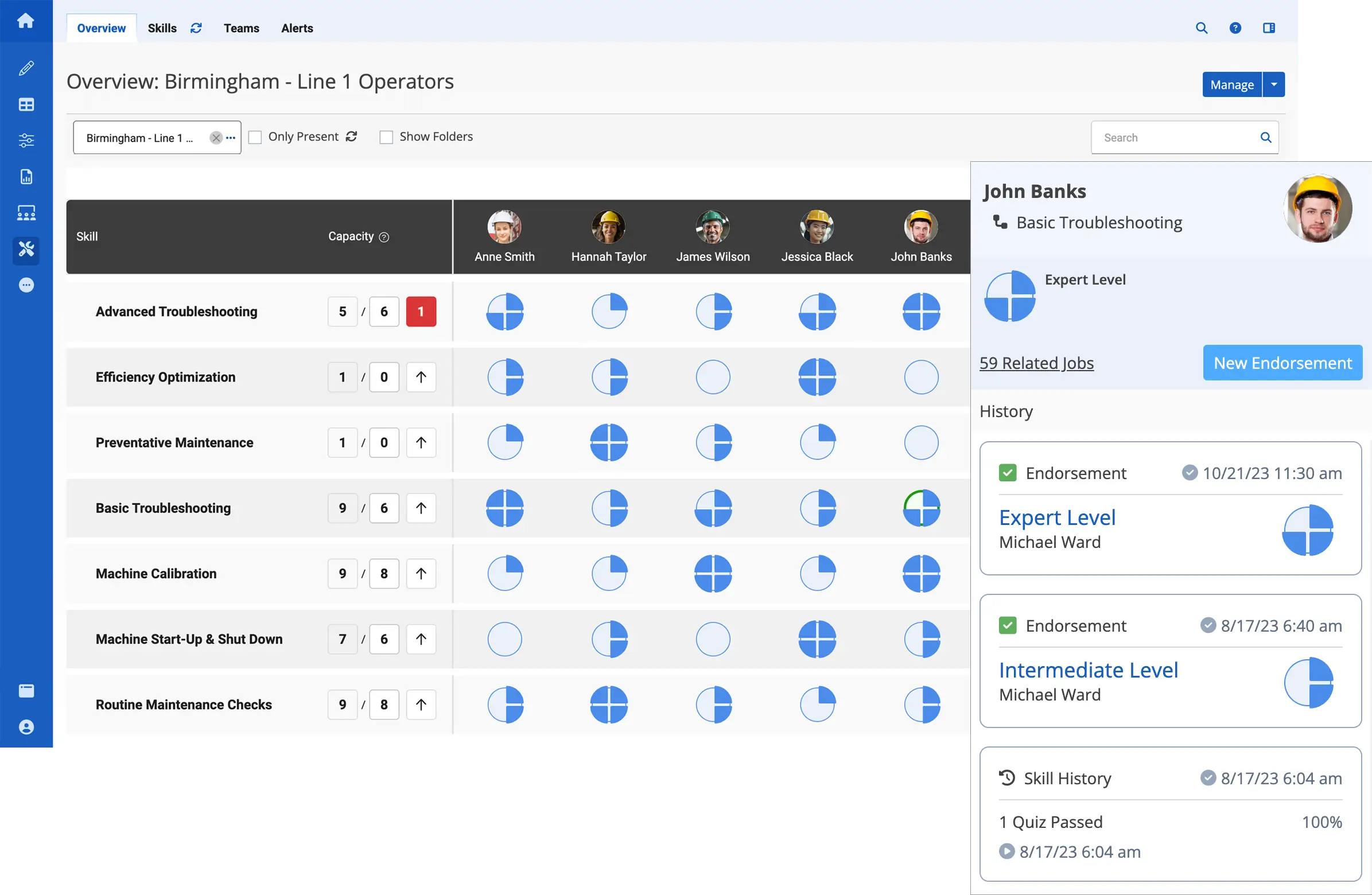
Priorizar los programas de capacitación y desarrollo continuos para el personal de fabricación. Dotar a los trabajadores de primera línea de las habilidades necesarias para adaptarse a las tecnologías en constante evolución y a los requisitos operativos. Utilizar sistemas de gestión del rendimiento y otras herramientas digitales como matrices de habilidades Identificar brechas de habilidades, establecer objetivos de capacitación y realizar un seguimiento del progreso, garantizando una fuerza laboral calificada y adaptable.

4. Evaluaciones de desempeño y retroalimentación periódicas:

Realice evaluaciones de desempeño periódicas que brinden retroalimentación constructiva y oportuna a los empleados. Aproveche estas evaluaciones para reconocer logros, abordar áreas de mejora y establecer nuevas metas de desempeño. Fomente una comunicación abierta entre gerentes y empleados para fomentar la mejora continua.

5. Integración con iniciativas de mejora continua:

Integrar sistemas de gestión del rendimiento con “kaizen” o mejora continua Iniciativas como Lean o Six Sigma. Utilice datos de métricas de rendimiento para identificar oportunidades de optimización de procesos, reducción de desperdicios y mejoras de eficiencia. Esto garantiza que la gestión del rendimiento no solo sea evaluativa, sino que contribuya activamente a la mejora continua de los procesos de fabricación.

El aprovechamiento de estas mejores prácticas contribuye a un proceso integral de gestión del rendimiento que alinea a las organizaciones de fabricación y su fuerza laboral de primera línea con los objetivos estratégicos, optimiza las operaciones y crea una cultura de mejora continua.

Estrategias de gestión del rendimiento clave para líderes de fabricación

Los siguientes son algunos ejemplos de estrategias de gestión del desempeño que los líderes de fabricación, gerentes de planta y supervisores de turno deben considerar al implementar su proceso de gestión del desempeño.

Objetivos de cambio de línea

Los fabricantes suelen utilizar sistemas de planificación y programación de la producción para gestionar eficazmente los turnos de línea y garantizar una transición fluida entre las diferentes configuraciones de producción. Si bien los turnos de línea en la fabricación suelen ser necesarios para adaptarse a las demandas cambiantes, introducir nuevos productos u optimizar la eficiencia, también pueden plantear desafíos, como tiempos de inactividad, problemas de control de calidad, fatiga de los empleados y problemas de planificación. Al establecer objetivos claros y medibles para cada turno de línea o trabajador individual, alineados con los objetivos de la organización, los líderes de producción pueden garantizar el cumplimiento de los objetivos de producción.

Reuniones individuales y comunicación

Los líderes de manufactura deben implementar una estrategia de gestión del desempeño que incorpore reuniones individuales y comunicación. Brindar retroalimentación constructiva periódica a los empleados sobre su desempeño puede mejorarlo y fomentar su compromiso. Ofrecer oportunidades de coaching y desarrollo para mejorar sus habilidades y capacidades.

Formación continua

La capacitación continua en manufactura implica capacitar a los trabajadores para que adquieran nuevas habilidades con regularidad. Es una excelente manera de mejorar el rendimiento y la innovación de los empleados, así como de atraer y retener a los mejores talentos. Un buen ejemplo de un modelo de aprendizaje continuo es everboarding, un enfoque moderno hacia la incorporación y capacitación de empleados que se aleja del modelo de incorporación tradicional de “una sola vez” y reconoce el aprendizaje como un proceso continuo.

Herramientas de gestión del rendimiento

La implementación de herramientas de gestión del rendimiento puede ayudar a automatizar la evaluación continua de los empleados, así como alinear su rendimiento con otros KPI clave de fabricación, como la calidad de la producción, el tiempo de funcionamiento de las máquinas y la utilización de la mano de obra. Estas herramientas también pueden utilizarse para identificar oportunidades de mejora continua. Esto permite a los líderes de fabricación adaptar y perfeccionar sus enfoques en función de la retroalimentación y los resultados.

Simplificando la gestión del rendimiento con herramientas digitales

De acuerdo a ForbesA medida que el futuro del trabajo evoluciona y cambia, también debe hacerlo la gestión del rendimiento; los métodos tradicionales pueden ya no ser tan exitosos en una era en la que la fuerza laboral cambia constantemente.

Las herramientas digitales, como las soluciones para trabajadores conectados y el análisis basado en IA, simplifican los sistemas de gestión del rendimiento al optimizar los procesos, mejorar la eficiencia y proporcionar información más precisa. La implementación de estas soluciones automatiza la recopilación de datos relacionados con el rendimiento de diversas fuentes, como trabajadores de primera línea conectados, dispositivos IoT, sistemas de software, etc. Esto elimina la necesidad de introducir manualmente los datos, reduce los errores y garantiza el acceso en tiempo real a información actualizada.

Al digitalizar el proceso de gestión del rendimiento, las organizaciones crean una plataforma centralizada para almacenar y gestionar datos relacionados con el rendimiento. Esta base de conocimiento centralizada facilita a gerentes y empleados el acceso a información relevante, el seguimiento del progreso y la colaboración para alcanzar los objetivos de rendimiento. Además, las soluciones para trabajadores conectados basadas en IA permiten el seguimiento digital del rendimiento, la planificación personalizada de la formación y el desarrollo de habilidades, la optimización del flujo de trabajo y un mejor mantenimiento predictivo.

Mejores prácticas de gestión del rendimiento en la fabricación

A través de estas herramientas y tecnologías digitales, las empresas manufactureras pueden simplificar los procesos de gestión del rendimiento, mejorar la eficiencia operativa y adaptarse a las demandas de una industria en rápida evolución, fomentando al mismo tiempo una cultura de mejora y desarrollo continuo para su fuerza laboral de fabricación.

Augmentir es el líder mundial solución de trabajador conectado, combinando tecnologías de inteligencia artificial y trabajadores conectados inteligentes para impulsar la mejora continua y optimizar las iniciativas de gestión del rendimiento en la fabricación.

Los líderes de la industria confían en Augmentir como socio de transformación digital que mejora la capacitación y el desarrollo, la asignación de personal y la excelencia operativa mediante nuestras soluciones True Productivity™ y True Performance™ basadas en IA, además de digitalizar y optimizar flujos de trabajo complejos, el seguimiento de habilidades y mucho más mediante nuestra suite patentada para trabajadores inteligentes y conectados. demostración en vivo Hoy para aprender más.


Vea Augmentir en acción
Contáctenos para una demostración personalizada

Conozca la diferencia entre el desarrollo de habilidades y la capacitación en manufactura, su importancia y cómo se puede mejorar su gestión a través de metodologías de aprendizaje continuo y tecnología emergente.

A primera vista, la capacitación y el desarrollo de habilidades parecen sinónimos y a menudo se usan indistintamente, pero tienen diferentes propósitos y objetivos. Sin embargo, a pesar de estas diferencias, ambos son igualmente importantes para cualquier organización, especialmente en el caso de la industria manufacturera. Según Revista de formación, 57% de las organizaciones manufactureras informaron aumentos en el presupuesto para capacitación y desarrollo de la fuerza laboral para abordar la creciente brecha de habilidades y la escasez de mano de obra calificada.

La diferencia entre el desarrollo de habilidades y la capacitación en la manufactura

En su nivel más básico, la capacitación es el proceso que utilizan las empresas para desarrollar las habilidades de los nuevos empleados, de modo que estén bien preparados para desempeñar el puesto para el que fueron contratados. Por otro lado, el desarrollo de habilidades incluye la formación continua, la mentoría y las experiencias profesionales que ayudan a los empleados a desarrollarse para futuros puestos y oportunidades.

Ambos son extremadamente valiosos para el crecimiento y el éxito organizacional general; sin embargo, es fundamental aplicarlos en el momento y la forma adecuados. Lea más sobre el desarrollo de habilidades y la capacitación en manufactura, su importancia y cómo pueden mejorarse mediante la aplicación adecuada de la tecnología de aprendizaje.

¿Qué es el desarrollo de habilidades en la manufactura?

El desarrollo de habilidades va más allá de la formación, ya que busca mejorar un conjunto más amplio de competencias y capacidades. Se centra en la creación de una fuerza laboral más integral y adaptable, abarcando no solo la adquisición de habilidades específicas, sino también la mejora de la capacidad de resolución de problemas, el pensamiento crítico, la creatividad, la adaptabilidad y el aprendizaje continuo.

El desarrollo de habilidades en la manufactura se refiere al proceso de mejorar los conocimientos, las habilidades y las competencias de las personas que participan en el proceso de fabricación. Implica brindar capacitación y formación a trabajadores, ingenieros y técnicos para mejorar sus habilidades técnicas, operativas y de resolución de problemas. Al brindar oportunidades de capacitación y desarrollo, las organizaciones manufactureras pueden garantizar que su fuerza laboral posea las habilidades y los conocimientos necesarios para realizar sus trabajos de manera eficaz y eficiente.

Plantilla de matriz de habilidades
Plantilla gratuita
Empieza a monitorizar las habilidades, certificaciones, progreso de desarrollo y planificación de la capacidad de tus empleados con nuestra plantilla gratuita de matriz de habilidades de Excel. Descarga nuestra plantilla para empezar y descubre más sobre cómo monitorizar y gestionar digitalmente las habilidades de tus empleados con Augmentir.


Muchas industrias manufactureras enfrentan una escasez de trabajadores cualificados. Los programas de desarrollo de habilidades ayudan a cubrir esta carencia capacitando a los empleados actuales o a los nuevos empleados en las competencias requeridas.

En general, el desarrollo de habilidades en la manufactura es crucial para mantener la competitividad en una industria en constante evolución. Garantiza que la fuerza laboral se mantenga adaptable, cualificada y capaz de satisfacer las cambiantes demandas de los procesos de manufactura modernos.

Consejo profesional

Implementando gestión de habilidades Los programas de software permiten a las organizaciones manufactureras digitalizar y rastrear eficazmente las habilidades de los trabajadores, el progreso del desarrollo y asignar trabajo de manera inteligente en función de las competencias de las habilidades, mejorando la asignación del trabajo y la utilización de la fuerza laboral.

A

¿Qué es la capacitación en manufactura?

La capacitación en manufactura se centra principalmente en impartir conocimientos, habilidades o información específicos a las personas. A menudo implica programas estructurados y organizados diseñados para enseñar a los empleados a realizar tareas específicas u operar maquinaria y equipo. La capacitación suele ser de menor duración y puede ser específica para una tarea o un puesto. Está diseñada para que los empleados alcancen rápidamente un cierto nivel de competencia en su puesto actual.

El tipo específico de capacitación requerida en manufactura depende de las funciones y responsabilidades de las personas involucradas, los procesos de la empresa y el sector en el que operan. La capacitación en manufactura es esencial por varias razones:

  • SeguridadLos procesos de fabricación suelen implicar maquinaria, equipos y materiales que pueden ser peligrosos. Una capacitación adecuada garantiza que los empleados comprendan y cumplan los protocolos de seguridad, lo que reduce el riesgo de accidentes y lesiones.
  • Control de calidad: Calidad en la fabricación Es un factor crítico y esencial. Los programas de capacitación enseñan a los empleados a mantener una calidad constante del producto mediante mediciones precisas, inspecciones y el cumplimiento de los estándares de calidad.
  • Eficiencia operativa:La capacitación ayuda a los empleados a ser más eficientes en sus tareas, reduciendo el tiempo de inactividad, minimizando el desperdicio y optimizando los procesos de fabricación.
  • TecnologíaLa fabricación se basa cada vez más en la tecnología. La capacitación proporciona a los empleados las habilidades necesarias para operar y mantener maquinaria y sistemas avanzados.
  • ProductividadLos trabajadores comprometidos tienden a ser más productivos, lo que contribuye a aumentar la producción y la rentabilidad de la empresa manufacturera.
  • CumplimientoLa fabricación está sujeta a diversas regulaciones y estándares de la industria. La capacitación garantiza que los empleados comprendan y cumplan estos requisitos, evitando así problemas legales y regulatorios.

Los programas de capacitación efectivos están diseñados para alinearse con las metas y objetivos de la organización, garantizando que la fuerza laboral esté bien preparada y sea capaz de contribuir al éxito de las operaciones de fabricación.

En resumen, la capacitación en manufactura es un subconjunto del desarrollo de habilidades, con un enfoque más específico en la enseñanza de habilidades y conocimientos relacionados con el trabajo. El desarrollo de habilidades, por otro lado, es un proceso más integral y continuo que busca desarrollar una fuerza laboral integral y adaptable, capaz de afrontar los desafíos cambiantes de la industria manufacturera. Tanto la capacitación como el desarrollo de habilidades son importantes para el éxito de una organización manufacturera y, a menudo, se complementan para formar una fuerza laboral cualificada y competente.

¿Cómo puede la tecnología mejorar el desarrollo y la capacitación de habilidades de fabricación?

La tecnología puede mejorar significativamente el desarrollo y la capacitación en habilidades de fabricación, haciendo que el proceso sea más eficiente, eficaz y accesible. La incorporación de estos avances tecnológicos en el desarrollo y la capacitación de habilidades de fabricación puede generar una fuerza laboral más capacitada y adaptable, mayor seguridad, menores costos de capacitación y una mayor eficiencia general de fabricación.

Por ejemplo, la tecnología permite a los expertos asistir y guiar remotamente a los aprendices en tareas complejas. Los trabajadores pueden usar gafas inteligentes o dispositivos móviles para compartir transmisiones de video en vivo y recibir instrucciones en tiempo real. Las soluciones para trabajadores conectados basadas en IA pueden ayudar a crear rutas de aprendizaje personalizadas para los aprendices, en función de su trabajo, su progreso y su estilo de aprendizaje.

Las plataformas inteligentes para trabajadores conectados, los sistemas de gestión del aprendizaje (LMS) y las aplicaciones móviles pueden brindar acceso a una amplia gama de materiales de capacitación, incluyendo videotutoriales, módulos interactivos y evaluaciones. Estas plataformas permiten a los trabajadores aprender a su propio ritmo y según sus horarios, reduciendo la necesidad de capacitaciones presenciales costosas y que requieren mucho tiempo.

Augmentir es el líder mundial, Solución para trabajadores inteligentes y conectados Utilizamos las tecnologías de IA fundamentales que sustentan ChatGPT para optimizar la capacitación, la incorporación y el desarrollo de habilidades en manufactura. Las principales organizaciones manufactureras utilizan nuestro traje de trabajador inteligente y conectado, así como la información basada en IA, para fomentar entornos de aprendizaje continuo y hacer que los procesos de desarrollo de habilidades y capacitación sean más personalizados, accesibles y efectivos.

Programar una demostración en vivo para descubrir por qué los líderes de fabricación nos eligen para mejorar el ciclo de vida de la capacitación con herramientas de gestión de habilidades digitales, información en tiempo real y más.


Vea Augmentir en acción
Contáctenos para una demostración personalizada

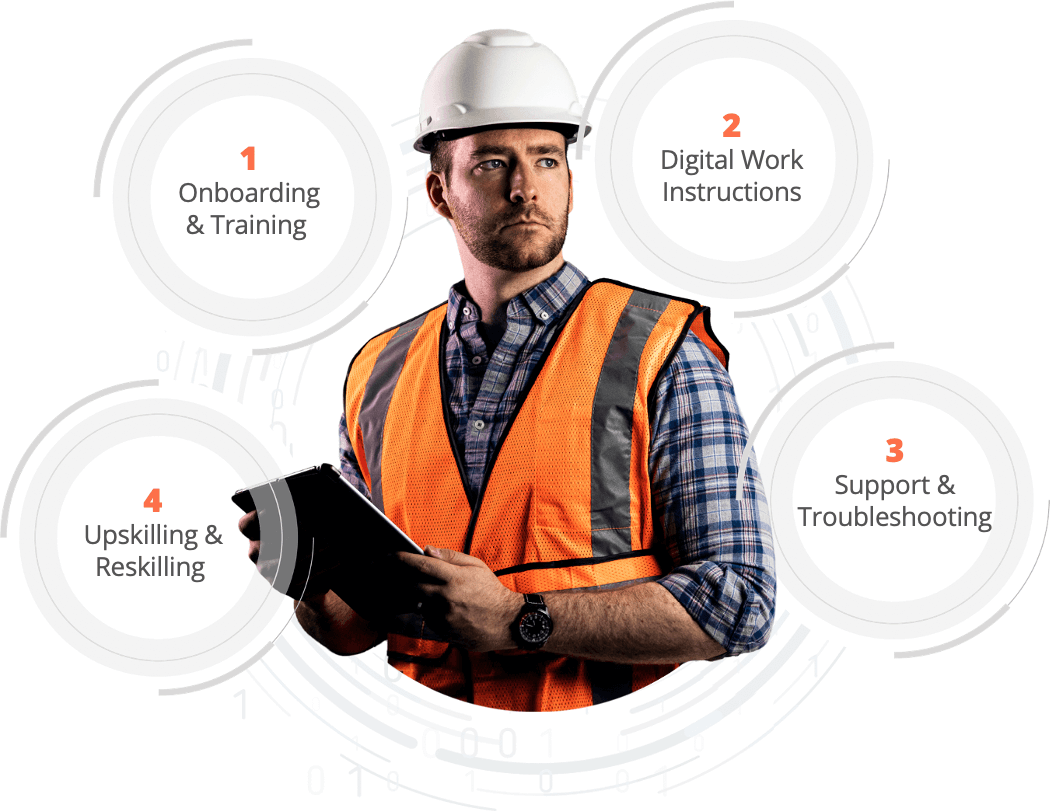
Learn the differences between onboarding and training in manufacturing, their benefits, and how to improve them with continuous learning.

Onboarding and training are essential components of integrating new employees into a manufacturing environment. Research by Grupo Brandon Hall found that organizations with a strong onboarding process improve new hire retention by 82% and productivity by over 70%. Additionally, research from NAM y The Manufacturing Institute has found that manufacturing organizations invest an average of 51.4 hours per employee in training and are increasing overall investment in training by an average of 60% in response to the growing skilled labor crisis.

onboarding vs training in manufacturing

Onboarding and training are two key components of a skilled workforce that, while similar, serve different purposes and cover distinct aspects of the employment process.

Both processes are crucial, as onboarding ensures that employees understand the organization’s broader context, and training ensures that they have the expertise to contribute to the manufacturing processes and meet quality and safety standards.

A successful combination of effective onboarding and comprehensive training can lead to more engaged, skilled, and productive employees in the manufacturing industry. Unfortunately, according to Gallup, only 29% of new hires say they feel fully prepared and supported to excel in their role after their onboarding experience.

Read below to learn more about the differences between onboarding and training in manufacturing, why they are both critical to manufacturing success, the benefits of improving them, and how continuous learning strategies coupled with soluciones para trabajadores conectados can improve both and deliver impressive results.

Breakdown of Onboarding and Training Differences

Onboarding in manufacturing is about orienting new hires to the company as a whole, while training is about equipping them with the specific skills and knowledge needed to perform their job functions effectively. Below a breakdown of the differences between onboarding and training in a manufacturing setting:

Incorporación

  • Purpose: Onboarding integrates a new employee into the organization and its culture. It aims to familiarize employees with the company, its policies and procedures, and their roles within the organization.
  • Focus: Onboarding focuses on introducing employees to the broader aspects of the company, such as its mission, values, and culture, as well as administrative and safety procedures.
  • Duración: Onboarding is typically a short-term process, often lasting a few days, but could extend to a few months in certain manufacturing environments.
  • Components: It may include activities like completing paperwork, understanding company policies, meeting the team, plant/site safety, and familiarizing a new hire with the physical workplace.

Capacitación

  • Purpose: Training in manufacturing is a more specific and in-depth process that imparts the knowledge, skills, and competencies necessary to perform the job effectively. It is task-oriented and aimed at ensuring that employees can carry out their roles proficiently.
  • Focus: Training focuses on the technical aspects of the job, safety protocols, equipment operation, quality standards, and other job-specific skills.
  • Duración: Training is an ongoing process and may vary in duration depending on the complexity of the role and the employee’s experience level.
  • Components: Training tends to include hands-on instruction, demonstrations, practice exercises, and assessments to ensure that employees gain the necessary skills and knowledge.
Consejo profesional

Both initial onboarding and ongoing training can be implemented with mobile learning solutions that leverage connected worker technology and AI to provide workers with bite-sized, on-demand training modules that they can access on smartphones or tablets. These modules can be developed with customized learning paths that are focused on the type of tasks and work employees are doing on the factory floor.

A

Why are training and onboarding important to manufacturing success

Onboarding and training are crucial to manufacturing success for several reasons including safety, compliance, quality, and more. A well-trained manufacturing workforce that has a deep understanding of company policies, its mission, and overall values drives successful initiatives by producing quality products, complying with both industry-wide and company-specific standards, and meeting production goals in a manner that is both safe and efficient.

The manufacturing industry is subject to numerous regulations related to safety, environmental practices, and product quality. Proper training ensures that employees are aware of and adhere to these regulations, reducing the risk of compliance violations and a well-structured onboarding program leads to lower turnover rates and a more effective and cohesive workforce, ultimately contributing to manufacturing success.

In summary, these two tools are essential in manufacturing for setting the stage for employee success and overall organizational success. Onboarding aligns new employees with the company’s culture, policies, and expectations, enhances their safety awareness, and fosters engagement and productivity, while training plays a pivotal role in contributing to manufacturing success by equipping employees with the knowledge, skills, and competencies necessary to perform their roles effectively.

What are the benefits of improving training and onboarding in manufacturing

Improving manufacturing employee onboarding and training offers several advantages, benefiting both the company and its employees. Comprehensive onboarding makes new hires feel connected to the company’s culture and values, while ongoing training can offer growth and development opportunities, leading to increased employee engagement and job satisfaction.

Companies with a skilled, well-trained workforce are more competitive in the marketplace, as they can produce higher-quality products at a lower cost and adapt to industry changes more effectively.

Training and development opportunities are often cited as a key factor in employee satisfaction. When employees feel that their skills are being enhanced and their careers are advancing, they are more likely to be satisfied with their jobs.

How continuous learning and connected worker solutions improve training and onboarding in manufacturing

Continuous learning and connected worker solutions can significantly enhance training and onboarding in manufacturing by providing more dynamic, effective, and adaptable approaches.

By incorporating continuous learning and connected worker solutions into the these processes, manufacturing companies can create more efficient, engaging, and rewarding experiences for employees. This not only accelerates the integration of new employees but also supports ongoing skill development and knowledge retention once on the job, ultimately improving productivity and the overall success of the organization.

connected worker as part of connected enterprise

Augmentir’s AI-based solución de trabajador conectado is being leveraged by manufacturing leaders to deliver continuous learning and development tools to optimize onboarding training for a rapidly changing and diverse workforce. Our innovative, smart connected worker suite is transforming how manufacturing organizations hire, onboard, train, and deliver on-the-job guidance and support.


Gestión de habilidades digitales en una fábrica sin papel

Programar una demostración en vivo today to learn how our smart, connected worker solutions, AI-driven insights, and digital skills management are optimizing training and onboarding programs, tracking individual and team progress, and delivering targeted training and upskilling.


Vea Augmentir en acción
Contáctenos para una demostración personalizada

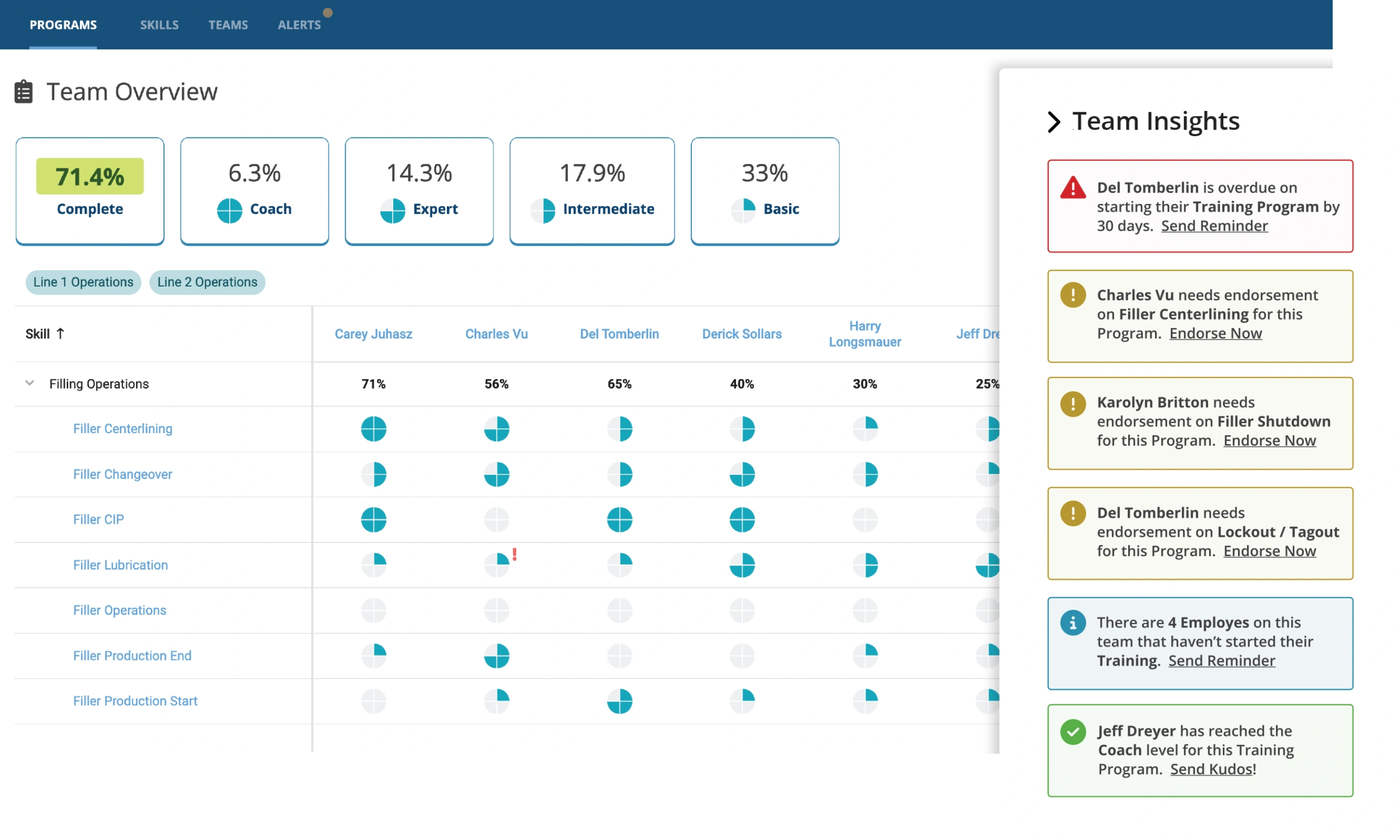
Learn how to apply everboarding in manufacturing, and how it is replacing traditional onboarding and training methods.

De acuerdo a Grupo Brandon Hall research, investment in employee training and development programs to enhance skills and knowledge is the highest-rated initiative globally to improve the employee experience. One highly effective approach towards revolutionizing training and onboarding is a continuous learning method called everboarding.

applying everboarding in manufacturing

Everboarding is a modernized approach toward employee onboarding and training that recognizes learning as a continuous and ongoing process. Its foundational characteristic is the belief that learning doesn’t stop after the initial onboarding period. Instead, everboarding emphasizes continuous skill development and employee knowledge enhancement throughout their careers.

Applying everboarding in a manufacturing environment involves tailoring continuous learning and development approaches to the unique needs and challenges of factory floor operations. As industrial processes evolve, employees must be routinely educated on process improvements, new technologies, safety standards, and efficiency initiatives.

Read on to learn more about how to apply everboarding to the factory floor and how fostering a culture of continuous improvement and learning keeps frontline workers safe, efficient, and engaged:

Steps for Implementing Everboarding in Manufacturing Operations

Everboarding in the context of the manufacturing industry refers to a forward-looking approach that ensures employees remain well-trained, adaptable, and aligned with industry standards throughout their tenure. This is essential in dynamic and fast-paced industrial environments like manufacturing. Here are some steps and strategies to begin implementing everboarding in your operations:

  1. Operationalize Learning: Develop and maintain a systematic approach to training and workforce development and ensure that ongoing training and development are available for all shop floor workers.
  2. Develop Learning Pathways: Create clear learning pathways and career development plans for employees. These pathways should outline the skills and knowledge required for career advancement within the manufacturing shop floor.
  3. Implement Digital Learning Platforms: Leverage digital learning platforms and smart, connected solutions to provide employees with access to training materials, videos, courses, and other resources. These platforms can track progress, and employees can learn at their own pace.
  4. Integrate Learning into the Workflow: Using digital, mobile, and connected technologies, organizations can integrate training into the factory floor for moment-of-need guidance and microlearning that allows frontline workers to stay compliant and operations to continue smoothly.
  5. Provide Feedback and Improvement Loops: Create a feedback mechanism where employees can provide suggestions for improving training programs and processes. Make sure to act on the feedback to continuously enhance the training experience.
  6. Initiate Regular Skill Assessments: Implement regular assessments and evaluations to identify areas where employees need further training or improvement.

Everboarding in a manufacturing factory floor environment is critical for keeping the workforce skilled, adaptable, and able to meet changing demands and technological advancements. By fostering a culture of continuous learning and improvement, you can ensure that the factory floor remains efficient and productive.

5 Useful Everboarding Technologies

Implementing Everboarding in manufacturing requires the use of various technologies to facilitate continuous learning and skill development. Here are five (5) useful technologies that can help speed the adoption of everboarding methods on the factory floor and support frontline workers on their continuous learning paths.

  1. Learning Management Systems (LMS): LMS platforms are essential for delivering and managing training content. They allow manufacturing companies to organize courses, track employee progress, and ensure compliance with training requirements.
  2. Connected Worker Applications: Connected worker applications provide mobile solutions, real-time data, and actionable insights that enable customized and personalized training dedicated to the needs of individual workers and specific tasks.
  3. Inteligencia artificial (IA): AI-driven systems can personalize training content based on employee performance and preferences. AI’s ability to process vast amounts of data, provide personalized experiences, and offer real-time feedback makes it a powerful tool for implementing everboarding.
  4. Internet de las cosas (IoT): IoT sensors can be integrated into manufacturing equipment to gather data on machine performance and employee interactions. This data can inform training needs and help identify areas for improvement.
  5. Wearable Technology: Wearable devices can be used for on-the-job training and performance monitoring. They are especially useful in high-risk manufacturing environments.

These technologies leverage connectivity, digital tools, and data to create a more dynamic and adaptive learning environment for frontline employees. By integrating emerging technologies like smart, connected worker solutions into manufacturing operations, companies can create a more agile and adaptive learning environment that supports the foundations of everboarding.

Consejo profesional

Digital training tools can help implement everboarding and improve learning speed and retention. For example, workers who need visuals or real-world scenarios can access them using AI-powered software to create a comprehensive everboarding and training program that supports frontline employees throughout the entire skills and training lifecycle.

A

Improving Manufacturing Training with Everboarding

Implementing new learning technologies in any industry is met with a certain number of challenges. This remains especially true for the factory floor where training and development are traditionally separate from the work being done, and where traditional onboarding has been a one-and-done type of approach.

However, because everboarding is a process of continuous learning, organizations can improve their industrial training and onboarding, ensuring employees continually acquire new skills and knowledge to adapt to evolving technologies and processes. This not only helps in training new employees but also enables continuous learning and skill development for the entire workforce, improving productivity, safety, and quality in the process.

Implementing everboarding in factory floor operations can seem complex but it is a rewarding process that can be streamlined through solutions like Augmentir’s solución de trabajador conectado. With our AI-driven insights, our connected solution reduces onboarding time and transforms workforce training, bringing learning to the factory floor through intelligent guidance that delivers information to workers at the point of need.

Learn how manufacturers are implementing Augmentir’s AI-driven connected worker tools to capture and digitize tribal knowledge, reskill and upskill their workers, and empower their frontline teams – schedule a demostración en vivo hoy.


Vea Augmentir en acción
Contáctenos para una demostración personalizada

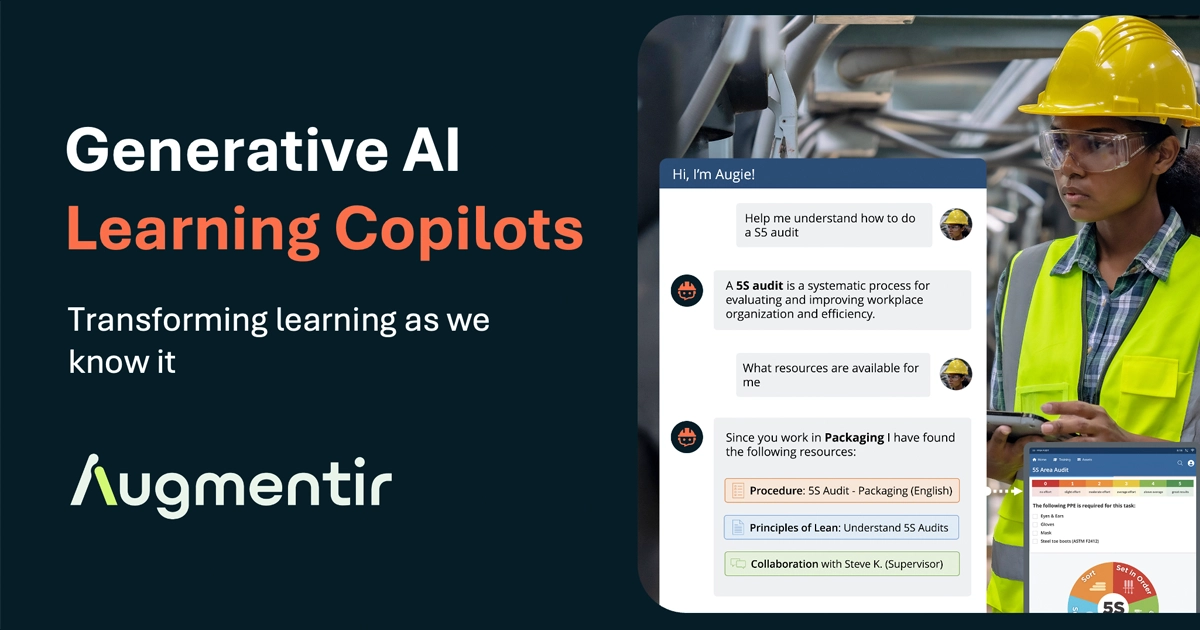
Watch Augmentir’s presentation at Learning & HR Tech 2024 and see how Generative AI Copilots transform learning and development in manufacturing.

Generative AI in learning and development has started to shape the future of HR across the board including attracting, developing, engaging, and retaining talent.

AI has revolutionized how organizations approach:

  • Talent acquisition – for smarter recruiting
  • Talent development – for skills analysis and performance evaluations
  • Worker relations – capitalizing on its ability to personalize employee relations
  • Workforce planning – leveraging its ability to make sense of data to perform more accurate forecasting and capacity planning
  • People analytics – using AI to make sense of employee data from an engagement and skills optimization standpoint
  • Performance management – relying on it for benchmarking and progress evaluation
  • HR operations – leveraging AI’s ability to automate and support onboarding and offboarding processes
  • Learning and development – using AI in everything from content creation to delivering personalized and adaptive content

generative ai learning copilots

However, Generative AI in learning and development has yet to make a significant impact on employees where it matters the most – in the flow of work.

This is where Generative AI learning copilots and AI-powered connected worker solutions come in. Together these technologies are transforming learning for frontline workers, improving onboarding, enabling learning in the flow of work, and driving more efficient upskilling and reskilling.

Watch our full presentation from Learning and HR Tech 2024 “Generative AI Learning Copilots: Transforming Learning as We Know It”, on-demand below.

Key Highlights:

  • Generative AI in learning and development has started to shape the future of HR across the board including attracting, developing, engaging, and retaining talent.
  • Deskless workers make up 80% of all workers globally and are underserved from a learning and development perspective, with 78% feeling they don’t have the right amount of training to succeed.
  • Generative AI Learning Copilots can generate training content, translate languages, provide real-time feedback, give on-demand guidance and answers, and serve as a digital performance support tool.

Generative AI Learning Copilots for Deskless Workers

Deskless workers, often referred to as “frontline workers”, generally do not sit in front of a desk and make up about 80% of all workers globally, they are on the front lines – in factories, at retail counters, construction sites, hospitals, and more.

While frontline workers and activities have undergone dramatic changes over the past few years, they are still woefully underserved from a learning and development standpoint.

  • 78% of frontline workers feel they don’t have the right amount of training to succeed at work
  • 65% want information on-demand and “in the flow of work”
  • Only 12% of HR operations leaders are actually satisfied with their L&D processes in support of their frontline employees

The reality is that traditional onboarding and training practices have been proven to be ineffective, however, much like AI has historically been used to improve the efficiency and output of machines, we can do the same with our frontline workforce.

AI learning and development tools and GenAI assistants can help:

  • Identify areas for content improvement, and implement those improvements
  • Measure training effectiveness
  • Create personalized, job-relevant training and curriculums
  • Measure and improve workforce effectiveness

Managing Manufacturing Workforce Challenges with GenAI Learning Copilots

The workforce crisis in manufacturing is accelerating and at the forefront of the minds of operations and HR leaders.

In fact, even if every skilled worker in America were employed, there would still be 35% more unfilled job openings in the manufacturing sector than skilled workers capable of filling them. Deloitte predicts that the skilled labor crisis will cost manufacturers upwards of $1 trillion by 2030.

In 2019, the average tenure in manufacturing was 20 years, the average time in position was 7 years, and the average 90-day retention rate was 90%. As of 2023, however, the average tenure is 3 years, the average time in position is 9 months, and the average 90-day retention rate was 50%.

These are representative of drastically different manufacturing realities. The workforce of 2019 is not coming back, and neither will productivity, unless organizations make significant investments and strides in supporting frontline workers with the appropriate tools and training. Luckily, smart connected worker and generative AI technologies offer a path forward.

Generative AI helps manufacturers answer:

  • What is the skills inventory of the team that is in attendance today?
  • Who can/should perform this work?
  • Who would benefit the most from targeted training?
  • Where should they focus on for process improvement?
  • What type of training would give them the biggest return?
  • What training materials need Improvement?

Generative AI-powered copilots and digital assistants can take this further, allowing frontline manufacturing workers access to vast amounts of knowledge in the flow of work when they need it most, helping to predict and prevent skills gaps before they impact production, and to design efficient and personalized development curriculums to shorten the time it takes for workers to be effective and competent in their positions.

¿Interesado en aprender más?

Si desea obtener más información sobre Augmentir y ver cómo nuestra plataforma de trabajadores conectados impulsada por IA mejora la incorporación, la capacitación, la gestión de habilidades y otros aspectos de aprendizaje y desarrollo en todas las organizaciones, programar una demostración con uno de nuestros expertos en productos.


Vea Augmentir en acción
Contáctenos para una demostración personalizada

La tecnología impulsada por IA puede ser la pieza faltante del rompecabezas para la crisis laboral actual.

It wouldn’t be fair to attribute all of manufacturing’s current labor shortage woes to the pandemic–there are a lot of factors contributing to this frustrating situation, and many of them were looming long before we ever heard of COVID-19. Did it make things worse? Probably. And the forecast doesn’t look very sunny if you believe what analysts have to say about it. However, despite the current crisis, there is hope yet for manufacturing, specifically in the form of AI and Connected Worker Technology.

Sure, the face of the workforce has changed dramatically. The pool of potential laborers has shrunk. Businesses are being forced to hire people traditionally considered under-qualified. And that leads to a whole host of other complications, including a drop in operational efficiency, a rise in safety issues, and more. The pessimists out there would only see the threat to the global market these challenges pose–the manufacturing industry makes between 11 and 12 percent of the US economy after all.

Good thing we’re optimists at heart! Behind every challenge is an opportunity, as far as we’re concerned. And when it comes to this challenging labor market in particular, we see a huge opportunity for businesses to work with what they’ve got, and still reach operational goals. We have the potential to assess how every worker performs on the job, regardless of the experience and skill set they bring on day one, and use that information to improve individual and enterprise-wide performance. Puts a new light on the labor shortage, doesn’t it?

You can’t fix what you can’t see.

We know using data is important to directing and improving operations–that’s business best practices 101. But insights drawn are only as good as the data itself. And even though there can’t be many businesses out there who haven’t yet jumped on the digital transformation bandwagon, we suspect a lot still rely on outdated data collecting and reporting mechanisms. Those digital spreadsheets had their moment, but we’ve got better options now. Maybe you opted for a Bluetooth software program or distributing a digital survey for your workers. But even with those innovations, what do these data indicators really tell you? Is this reliable and usable information? We didn’t think so either.

Imagine what you could do with real-time data, rather than a summary of operational KPIs at the end of set periods? Even better–imagine capturing the performance metrics of each individual worker rather than their self-generated assessments and observations and having the potential to use that knowledge to improve their skill set and operational proficiency. That’s when data becomes intelligence. And that intelligence has the potential to become so valuable to your enterprise that you’ll wonder how you ever operated without it.

Not convinced you could benefit from data at that level of individual performance? Let us draw an analogy we think you’ll appreciate.

Think of each worker as a newly licensed driver; what happens after passing the road test?

Remember the day you got your driver’s license? We spent hours, if not days and weeks practicing behind the wheel, eagerly waiting to be evaluated by a driving instructor. And let’s be honest, plenty of us winged it, too. Either way, once you show them you can do a three-point-turn and know to stop at the flashing pedestrian crossing sign, everyone walks away with the proof of their proficiency–a driver’s license. 

Then what happened? Nothing. Maybe a celebratory high-five and then eventually years of driving. In one, five, or ten years, what do we know about each person’s capabilities? Unless they’ve wracked up a stack of tickets for traffic violations, we don’t know anything. For all we know, they haven’t sat behind the steering wheel since passing. There is no mechanism to re-assess whether drivers are highly skilled or at-risk of creating an accident in operations.

Now what if we looked at our frontline workers through that lens? You know when they were hired that they could perform X, Y and Z. Some could do even more. But what about after that? What if you could assign an AI-based driver instructor to follow each new driver around for ongoing assessment and intervention in the moment of need?

Put smart connected worker technology in the passenger seat

Adopting connected worker technology powered by artificial intelligence (AI) increases the reliability and credibility of data by analyzing employee performance in ‘real-time.’ That individualized data can be used to connect workers with a company’s digital library of training tools and resources, having an immediate impact on operational proficiency and cultivating a healthy learning environment for workers.

Connected worker technology that leverages AI offers self-guided learning processes when opportunities are identified, reduces human error and improves safety, provides updates on pressing issues and equipment failures and access to a variety of applications. Who wouldn’t want to work for an organization like this? One that offers a high probability of job satisfaction and encourages personal skill development? A culture like that can help the operation on many levels, from reducing operational costs to attracting new employees. 

What now? There is only one connected worker solution that can provide this level of intelligence on your workforce–contact us to learn more about how Augmentir can benefit your business and ask for a demo!