Posts

Learn why integrations are key to the success of connected worker platforms, what systems should be integrated, and the benefits of a fully integrated connected worker solution.

Unlocking the potential of connected worker platforms becomes a game-changer when integrated with enterprise systems, giving them a live, closed loop connection to frontline processes and operations. This creates a truly connected enterprise that links diverse systems with the frontline workforce, paving the way for heightened efficiency, productivity, and safety.

connected worker platform integrations

However, a majority of connected worker platforms overlook the fact that connectivity doesn’t end with simply linking workers to their platform. They fail to recognize the immense benefits that live connections to enterprise systems of record bring to frontline business processes and activities.

Manufacturing success hinges on the seamless integration of connected worker platforms with legacy and enterprise systems to provide adequate support to frontline workers, giving them access to data and knowledge that can boost their efficiency and keep them safe.

Read below for more information on connected worker platform integrations; what they entail, which enterprise systems are essential for integration, and how AI-powered technology improves impact on frontline manufacturing activities.

Connected Worker Integrations: More than just an API

In manufacturing, it is critical that connected worker platforms are integrated with various enterprise systems to streamline operations and ensure that workers have the data and information they need at their fingertips. As critical as this is, most connected worker vendors believe that providing an open API is sufficient, and even boast that they integrate to enterprise systems, when in fact they place this burden on their customers.

Having an API is not enough

There are several not-so-obvious aspects to connected worker platform integrations, including:

  • Connected worker integrations with enterprise applications, even streamlined ones, have essential requirements such as logic that needs to be written, customized, run, and supported. Most, if not all, of this logic is initiated by the connected worker platform, propagating events and data from shop floor processes to the associated enterprise system of record.
  • Connected worker platforms with just an “API” require all of this functionality to be developed, hosted, and supported externally. The responsibility is then on the customer to build a custom product and select and support the hosting environment. This effort (building, hosting, and support) can cost between $50K and $150K to build and test, and then another $50K – $150K annually for 5 x 9 support. And, the customer is responsible for maintaining an SLA acceptable to the business (99.9% being typical).
Pro Tip

It’s critical that connected worker platforms include “platform-as-a-service” (Paas) capabilities that provide the ability to write, support, and execute both standard and custom integrations. These can be done by the platform provider, the customer, as well as third-party system vendors and system integrators. Providing PaaS capabilities puts the responsibility on the vendor for operating the integration service, and maintaining SLAs, geo-redundancy, disaster recovery, and privacy and security. In short, just saying “we have an API” places an undue burden on customers, and prevents building the sustainable connected enterprise necessary to remain competitive in today’s global economy.

A

Which Enterprise Systems Should You Integrate

In any industrial environment, connected worker platforms should be integrated with various systems to support operations, help with cooperation and communication, and gain valuable insights into frontline manufacturing processes. These integrations streamline activities, improve efficiency, and provide a unified digital environment that empowers frontline workers.

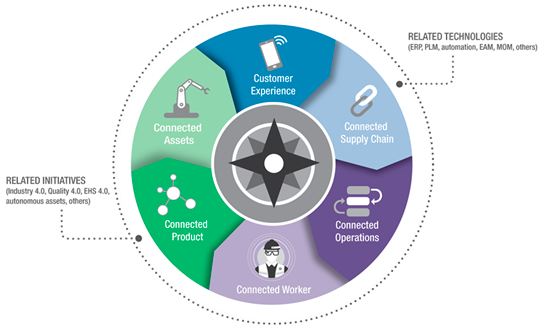
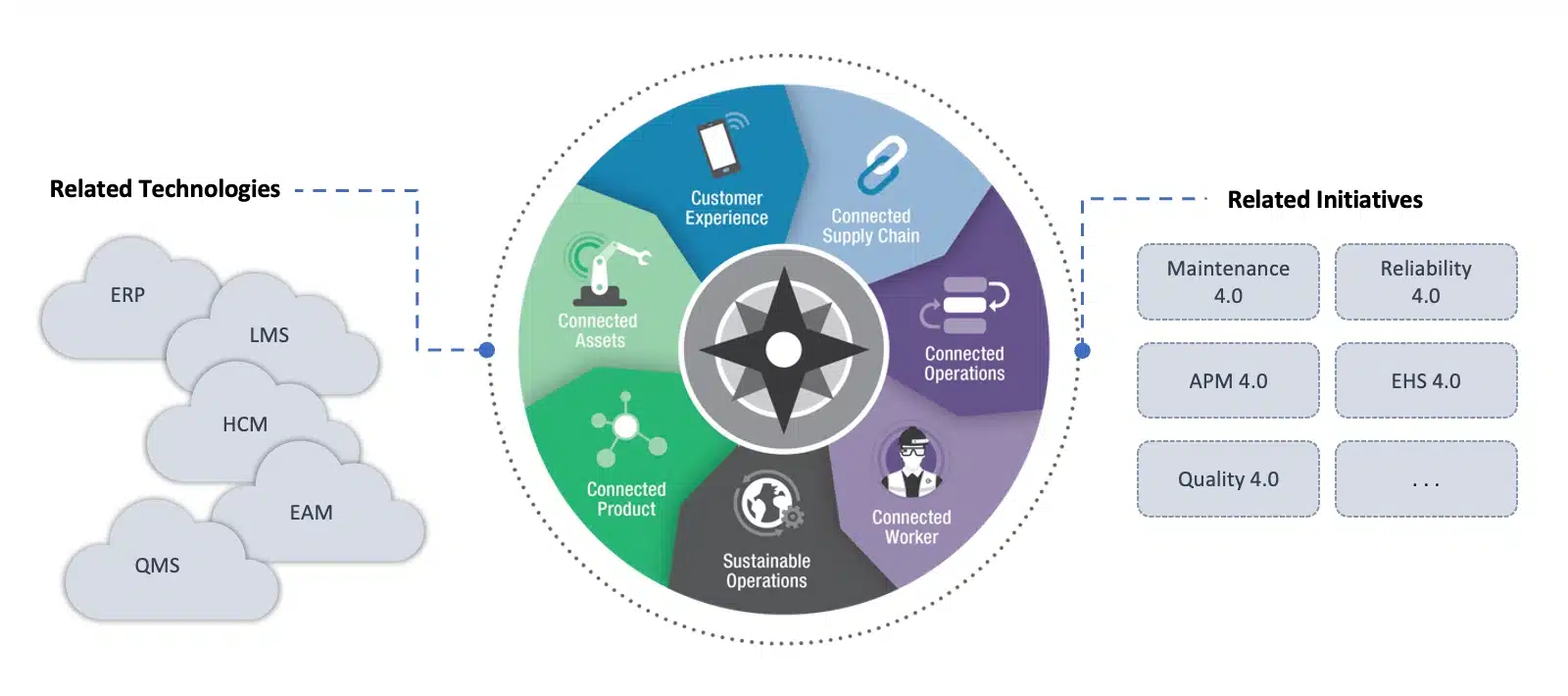
This concept of a connected enterprise spans several initiatives within an organization: assets and equipment, the products being manufactured, the end customer, operations, workers, and the entire supply chain, and is highlighted below using the Industrial Transformation (IX) Reference Architecture from LNS Research.

connected worker enterprise system integration

Examples of enterprise management systems of record that are key to connected worker success and should be integrated are:

  • ERP (Enterprise Resource Planning)
  • EAM (Enterprise Asset Management)
  • HCM (Human Capital Management)
  • HR, Training, and LMS (Learning Management System)
  • QMS (Quality Management Systems)
  • MES (Manufacturing Execution System)
  • CMMS (Computerized Maintenance Management System)
  • Supply Chain Management

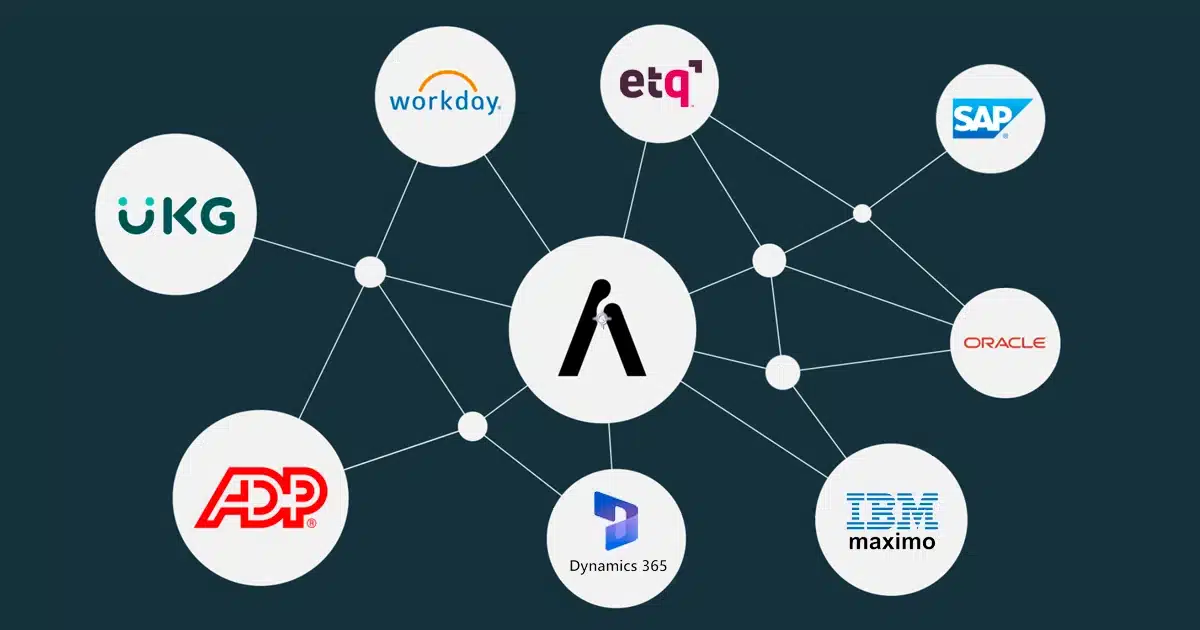
Enterprise systems such as ETQ, Workday, UKG, SAP, Oracle, IBM Maximo, Microsoft Dynamics 365, Salesforce, and ADP provide transformational value for a manufacturing company if they can be connected into frontline operations. By integrating connected worker platforms with these systems, manufacturers can create an interconnected environment that supports frontline workers and drives operational excellence. Ultimately, integration enhances collaboration, workforce visibility, decision-making processes, and overall operational efficiency, making connected worker platforms an indispensable component for manufacturing organizations.

Improving Integration Success Through Augmentir

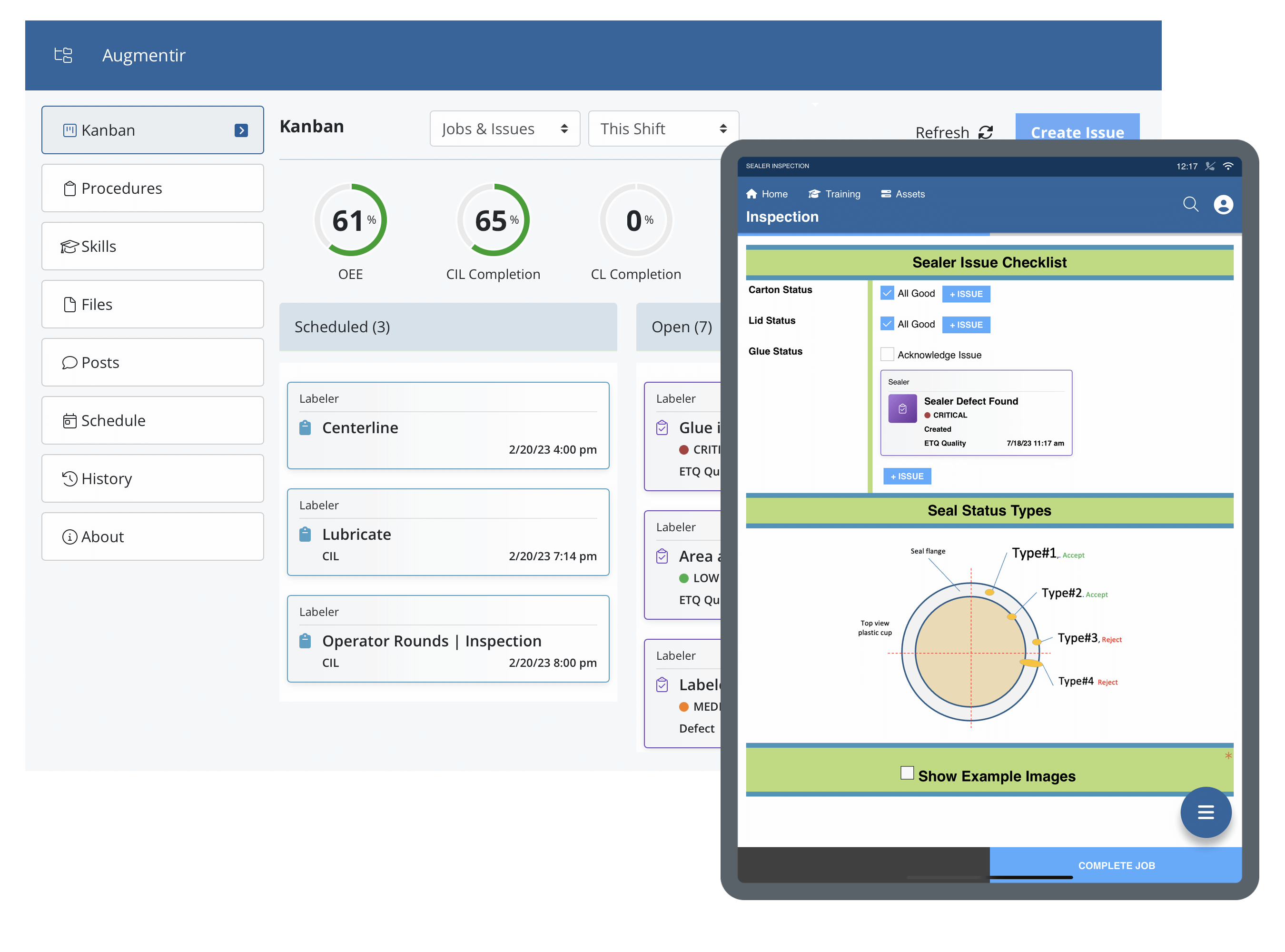
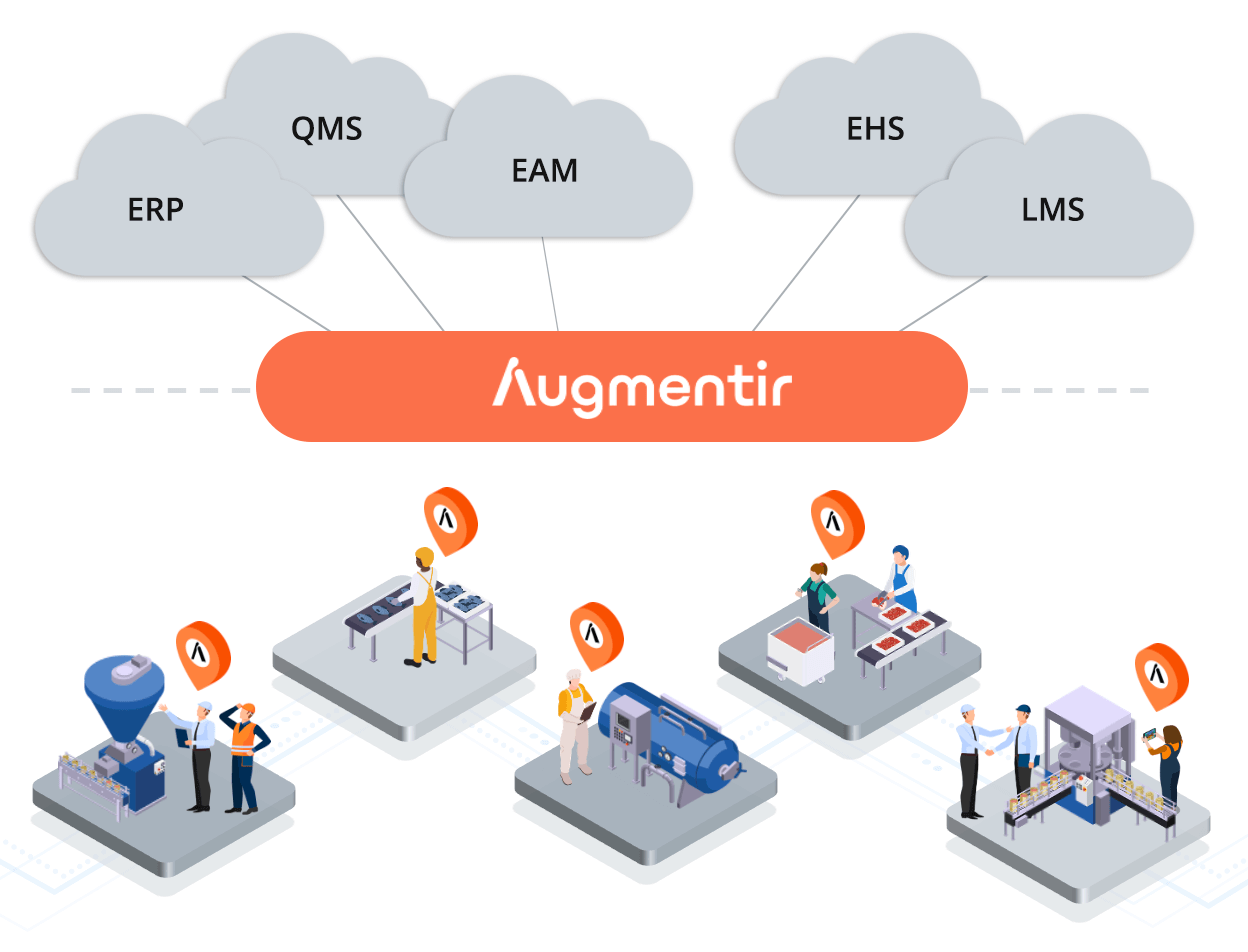
At Augmentir, we see integrations differently than other connected worker platforms. Our rich history of building integrations in the manufacturing space enabled us to design a connected worker solution that easily, bi-directionally, and securely integrates the enterprise systems of record to create closed loop processes involving the frontline workforce.

Augmentir has internal PaaS services to run connectors that we build and support for popular enterprise applications like SAP, Salesforce, ETQ, Oracle, IBM Maximo, and more. Additionally, our PaaS enables custom integrations to be built and executed for custom, and niche applications. All third-party integrations running in the Augmentir connected worker platform carry the same SLA and geo-redundant support. By facilitating connected worker platform integrations with enterprise systems in this way, we have provided leading manufacturers with increased workforce visibility, improved productivity, digitized and standardized processes, enhanced training and collaboration, and more.

augmentir enterprise integration

Furthermore, because we are the leading AI-powered connected worker provider, we have brought innovative generative AI technologies such as AI-driven analytics, machine learning algorithms, NLP, predictive maintenance, and industrial AI copilots to improve connected worker integrations with enterprise systems, providing real-time guidance, enabling predictive analysis, and enhancing communication and collaboration among workers.

Schedule a demo to learn more about our AI-powered connected worker solutions and how they are drastically improving frontline processes, training, and manufacturing activities.


See Augmentir in Action
Get in Touch for a Personalized Demo

AI-powered technology may be the missing puzzle piece for today’s workforce crisis.

It wouldn’t be fair to attribute all of manufacturing’s current labor shortage woes to the pandemic–there are a lot of factors contributing to this frustrating situation, and many of them were looming long before we ever heard of COVID-19. Did it make things worse? Probably. And the forecast doesn’t look very sunny if you believe what analysts have to say about it. However, despite the current crisis, there is hope yet for manufacturing, specifically in the form of AI and Connected Worker Technology.

Sure, the face of the workforce has changed dramatically. The pool of potential laborers has shrunk. Businesses are being forced to hire people traditionally considered under-qualified. And that leads to a whole host of other complications, including a drop in operational efficiency, a rise in safety issues, and more. The pessimists out there would only see the threat to the global market these challenges pose–the manufacturing industry makes between 11 and 12 percent of the US economy after all.

Good thing we’re optimists at heart! Behind every challenge is an opportunity, as far as we’re concerned. And when it comes to this challenging labor market in particular, we see a huge opportunity for businesses to work with what they’ve got, and still reach operational goals. We have the potential to assess how every worker performs on the job, regardless of the experience and skill set they bring on day one, and use that information to improve individual and enterprise-wide performance. Puts a new light on the labor shortage, doesn’t it?

You can’t fix what you can’t see.

We know using data is important to directing and improving operations–that’s business best practices 101. But insights drawn are only as good as the data itself. And even though there can’t be many businesses out there who haven’t yet jumped on the digital transformation bandwagon, we suspect a lot still rely on outdated data collecting and reporting mechanisms. Those digital spreadsheets had their moment, but we’ve got better options now. Maybe you opted for a Bluetooth software program or distributing a digital survey for your workers. But even with those innovations, what do these data indicators really tell you? Is this reliable and usable information? We didn’t think so either.

Imagine what you could do with real-time data, rather than a summary of operational KPIs at the end of set periods? Even better–imagine capturing the performance metrics of each individual worker rather than their self-generated assessments and observations and having the potential to use that knowledge to improve their skill set and operational proficiency. That’s when data becomes intelligence. And that intelligence has the potential to become so valuable to your enterprise that you’ll wonder how you ever operated without it.

Not convinced you could benefit from data at that level of individual performance? Let us draw an analogy we think you’ll appreciate.

Think of each worker as a newly licensed driver; what happens after passing the road test?

Remember the day you got your driver’s license? We spent hours, if not days and weeks practicing behind the wheel, eagerly waiting to be evaluated by a driving instructor. And let’s be honest, plenty of us winged it, too. Either way, once you show them you can do a three-point-turn and know to stop at the flashing pedestrian crossing sign, everyone walks away with the proof of their proficiency–a driver’s license. 

Then what happened? Nothing. Maybe a celebratory high-five and then eventually years of driving. In one, five, or ten years, what do we know about each person’s capabilities? Unless they’ve wracked up a stack of tickets for traffic violations, we don’t know anything. For all we know, they haven’t sat behind the steering wheel since passing. There is no mechanism to re-assess whether drivers are highly skilled or at-risk of creating an accident in operations.

Now what if we looked at our frontline workers through that lens? You know when they were hired that they could perform X, Y and Z. Some could do even more. But what about after that? What if you could assign an AI-based driver instructor to follow each new driver around for ongoing assessment and intervention in the moment of need?

Put smart connected worker technology in the passenger seat

Adopting connected worker technology powered by artificial intelligence (AI) increases the reliability and credibility of data by analyzing employee performance in ‘real-time.’ That individualized data can be used to connect workers with a company’s digital library of training tools and resources, having an immediate impact on operational proficiency and cultivating a healthy learning environment for workers.

Connected worker technology that leverages AI offers self-guided learning processes when opportunities are identified, reduces human error and improves safety, provides updates on pressing issues and equipment failures and access to a variety of applications. Who wouldn’t want to work for an organization like this? One that offers a high probability of job satisfaction and encourages personal skill development? A culture like that can help the operation on many levels, from reducing operational costs to attracting new employees. 

What now? There is only one connected worker solution that can provide this level of intelligence on your workforce–contact us to learn more about how Augmentir can benefit your business and ask for a demo!

August 13, 2021


Augmentir was recently recognized by Gartner in four separate Hype Cycle reports that cover technology innovation in manufacturing. These four reports include:

  • Hype Cycle for Manufacturing Digital Transformation and Innovation, 2021
  • Hype Cycle for Manufacturing Operations Strategy, 2021
  • Hype Cycle for Manufacturing Digital Optimization and Modernization, 2021
  • Hype Cycle for Frontline Worker Technologies, 2021

In these reports, Gartner highlights Augmentir as a key software vendor in the Connected Factory Worker and Immersive Experiences in Manufacturing Operations categories.

  • Connected Factory Worker: Connected factory workers use various digital tools to improve the safety, quality, and productivity of the jobs they perform. This technology helps connect workers to the “digital fabric” of the business, providing insight into the tasks they perform so that they can be optimized and continually improved on.
  • Immersive Experiences in Manufacturing Operations: According to Gartner, immersive experiences refer to enabling the perception of being physically present in a nonphysical world or enriching people’s presence in the physical world with content from the virtual world. Gartner sees using immersive experiences for quality and maintenance tasks, remotely connecting and collaborating with employees that are not able to be on-site, or wearables for safety management.

These hype cycle reports and innovation profiles are provided by Gartner to help organizations decide which new innovations and technology to adopt, as well as what value they can provide to their manufacturing operations.

Digital Transformation in Manufacturing

According to Gartner, the manufacturing industry is being transformed by new business models and strategic, innovative technologies that fit within Industrie 4.0. Manufacturers can capitalize on advancements made in artificial intelligence (AI), visualization, collaboration, and greater connectivity across enterprises.

This was the focus in Gartner’s recently published reports, which revealed opportunities for manufacturing leaders to gain business advantages through concepts and technologies that improve productivity and decision making. Besides adding value to manufacturing businesses, they increase windows of competitive advantage.

The Connected Worker – A first step for Digital Transformation in Manufacturing

Manufacturers are beginning to recognize just how integral frontline workers are to their company’s digital fabric and that overlooking these workers has caused their digital transformation efforts to fall short of their objectives.

These same industry leaders are now investing in an integrated approach – empowering their frontline teams with connected worker solutions that utilize technology such as mobile and wearable devices, augmented and mixed reality (AR/MR), remote collaboration tools, and artificial intelligence (AI). Connected worker solutions that bring together these technologies are helping to connect a new class of workers and are allowing organizations to proactively and continually deliver the right level of training, support, guidance, and improvement.

Optimizing Worker Performance with AI

As workers become more connected, companies have access to a new rich source of activity, execution, and tribal data, and with proper AI tools can gain insights into areas where the largest improvement opportunities exist. Artificial Intelligence lays a data-driven foundation for continuous improvement in the areas of productivity, quality, and workforce development, setting the stage to address the needs of a constantly changing workforce.

Our view at Augmentir is that the purpose of a connected worker platform isn’t simply to deliver instructions and remote support to a frontline worker, but rather to continually optimize the performance of the connected worker ecosystem. Artificial intelligence is uniquely able to address the fundamental macrotrends of skills variability and the loss of tribal knowledge in the workforce, and creates a foundation for data-driven improvements to operational performance and continuous improvement.

“AI will play a critical role in the long-term success of connected factory workers. As more information is curated and made available, algorithms must be continually trained in alignment with continuous improvement initiatives, creating the potential for enhanced root cause analysis.”

Gartner

With an ecosystem of content authors, frontline workers, subject matter experts, operations managers, continuous improvement engineers, and quality specialists, there are dozens of opportunities to improve performance using AI. For example, after Augmentir is deployed for a number of months, our AI engine will start identifying patterns in the data that will allow you to focus your efforts on the areas that have the biggest customer satisfaction, productivity, and workforce development opportunities. This will allow you to answer questions such as:

  • Where should I invest to get the biggest improvement in operational performance?
  • What manufacturing tasks have the largest productivity or quality opportunity?
  • Where would targeted training give me the biggest return?

Augmentir’s AI continuously updates its insights to enable companies to focus on their largest areas of opportunity, enabling you to deliver year over year improvements in key operational metrics.

Interested in learning more?

If you’d like to learn more about Augmentir and see how our AI-Powered connected worker platform improves safety, quality, and productivity across your workforce, schedule a demo with one of our product experts.


August 16, 2021

Augmentir was once again recognized by Gartner as a key vendor for Connected Factory Worker technology. In the latest Gartner Hype Cycle for Consumer Goods, Augmentir was highlighted as an important vendor for Connected Factory Worker software and Immersive Experiences in Manufacturing. This marks the seventh time in 2021 that Augmentir has been recognized by Gartner for leadership in emerging technologies for manufacturing.

Digital Technology – A Key Priority for Consumer Goods CEOs

This Gartner report identifies technology as a key priority for consumer goods CEOs, and states that “79% of Consumer Goods CEOs plan to increase their investment in digital capabilities.”

According to the hype cycle report, “Investments in long-delayed digital initiatives came to the forefront due to the pandemic.” Digital transformation initiatives were put into focus and brought to the forefront due to the impact of the pandemic, increased remote working, and supply chain disruptions, and many leading consumer goods manufacturers were “jolted to invest in long-delayed digital plans.”

Gartner highlighted Connected Factory Workers and Immersive Experience in Manufacturing as offering transformational benefits for consumer goods manufacturers, and mentions Augmentir as a key software vendor in each category.

  • Connected Factory Worker: Connected factory workers use various digital tools to improve the safety, quality, and productivity of the jobs they perform. In consumer goods manufacturing, this may include enabling digitization of maintenance procedures, changeover procedures, EHS lockout/tagout procedures, quality checklists, and plant walkabouts via digitized step by step instructions or guided workflows. This technology helps connect workers to the “digital fabric” of the business, providing insight into the tasks they perform so that they can be optimized and continually improved on.
  • Immersive Experience in Manufacturing Operations: According to Gartner, immersive experiences refer to enabling the perception of being physically present in a nonphysical world or enriching people’s presence in the physical world with content from the virtual world. Gartner sees using immersive experiences as important for “accelerating problem solving and broadening continuous improvement dialogue through virtual or remote access.” This approach is being use for quality and maintenance tasks, remotely connecting with employees that are not able to be on-site, or wearables for safety management.

These hype cycles and innovation profiles are provided by Gartner to help organizations decide which new innovations and technology to adopt and when, as well as what value they can provide to their manufacturing operations.

Accelerating Your Digital Journey with Augmentir

Many leading consumer goods manufacturers, including Colgate-Palmolive, have adopted Augmentir to connect their frontline workforce and accelerate their digitization efforts. Augmentir’s AI-based connected worker platform offers connected worker technology with augmented work instructions. Equipped with digital devices that could include tablets, mobile phones, or even AR-enabled industrial smart glasses, frontline workers are able to receive fully augmented, guided instructions on any device to improve productivity, quality and allow workers to perform their jobs more independently. These help guide workers with visual aids, AR/MR experiences, and contextual information.

For example, since the selection of Augmentir in November 2020, Colgate has already seen tremendous progress towards their digital transformation goals and has digitized over 1000 workflows across 10 global plants, resulting in significant value and productivity improvements in maintenance tasks, line changeovers, and shift changes.

Optimizing Worker Performance with AI

Gartner further recommends that consumer goods manufacturers: “Make your focus the creation of a “data-driven” culture in manufacturing operations.” This includes not only integrating factory workforces with their virtual and physical surroundings, but also driving a culture change towards data-driven performance optimization and workforce development.

Artificial Intelligence (AI) is a key foundation for data-driven transformation within the manufacturing workforce.

As workers become more connected, companies have access to a new rich source of activity, execution, and tribal data, and with proper AI tools can gain insights into areas where the largest improvement opportunities exist. Artificial Intelligence lays a data-driven foundation for continuous improvement in the areas of productivity, quality, and workforce development, setting the stage to address the needs of a constantly changing workforce.

Our view at Augmentir is that the purpose of a connected worker platform isn’t simply to deliver instructions and remote support to a frontline worker, but rather to continually optimize the performance of the connected worker ecosystem. AI is uniquely able to address the fundamental macrotrends of skills variability and the loss of tribal knowledge in the workforce. With an ecosystem of content authors, frontline workers, subject matter experts, operations managers, continuous improvement engineers, and quality specialists, there are dozens of opportunities to improve performance.

Interested in learning more?

If you’d like to learn more about Augmentir and see how our AI-Powered connected worker platform improves safety, quality, and productivity across your workforce, schedule a demo with one of our product experts.

Prior to Augmentir, our founding team was involved in founding Wonderware Software in 1987, Lighthammer in 1997, and ThingWorx in 2008. In 2017, we recognized that the technology and market forces were aligned yet again, for a fourth industrial software revolution. A revolution that focused on increasing the productivity and quality of processes involving front-line workers.

Times have changed since 1985 when relying on tribal knowledge was the only option for a frontline worker, and today, via digital transformation efforts, we are lucky enough to have new technologies and resources that enable frontline workers to do their best work in a complex world. Although taking the steps toward digital transformation can seem scary or overwhelming, the longer you wait and “do nothing”, the more difficult it becomes to modernize. Not having the proper resources or being unsure about the digital transformation process are common hesitations for most organizations.

Beginning your digital transformation is like beginning your journey to the gym after a long day. You can come up with a million excuses for not wanting to get your workout and usually, the hardest part is actually taking the first step to get there. But once you’ve started, you never regret it! According to LNS Research, most manufacturing companies have at least begun their digital transformation journey, and for those that have not, the hardest part is just taking the first step.

Here’s what doing nothing is costing you today.

“Doing nothing” is costing you $234,900 every year with 1 changeover

If you could reduce variability in the execution of one changeover you could save 15,660 hours each year.

If the variability in completing a changeover between 2 operators is 1 hour and a changeover is performed 1/day, you are losing 261 hours each year for 1 operator.

Now, let’s look at shifts – if the average variability between A-shift, and B-Shift is +1 hour and C-Shift is +2 hours – with a total of 20 frontline workers on each shift and each operator performing 1 changeover /day the variability in hours relative to A-Shift is equal to 60 hours every day and 15,660 hours each year.

Multiply that times at the national average of $15/technician, over the course of 1 year, “doing nothing” for just 1 task is costing you $234,900 in employee time alone.

Quantify increased throughput, proficiency, productivity, and quality though frontline digital transformation, and there is even more impact!

“Doing Nothing” for manual data entry is costing you $97,875 per year

If you could save 15 minutes per day for an operator by eliminating data entry, after 1 year you would save your employee 3,915 minutes!

Multiply that time across 100 employees at the national average of $15/technician, “doing nothing” is costing you $97,875 per year.

“Doing Nothing” for apprenticeship programs is costing you $5,742,00

The average time for a new unskilled hire in an apprenticeship program is 2 years. If you could reduce the time that the new hire spends in the apprenticeship by 25%, you would save 1,044 hours for each new worker you hire. Reducing apprenticeship time by 50% would save 2,088 hours for each new hire. Reducing apprenticeship by 50% for 50 unskilled new hires would save you 208,800 hours.

Multiplying that time at the national average of $15/hour across 50 new hires, “doing nothing” to reduce a 2 year apprenticeship program by 50% is costing you $1,566,000.

Quantifying the impact on the skilled workers giving their time to the apprenticeship program, at $40/hour across 50 new hires amounts to an additional $4,176,000.

Why not start today?

If increasing proficiency can pave the way towards frontline worker digital transformation and save you the cost of doing nothing, why wouldn’t you start today?

If reducing variability can pave the way towards frontline worker digital transformation and save you the cost of doing nothing, why wouldn’t you start today?

If one simple digital procedure can pave the way towards frontline worker digital transformation and save you the cost of doing nothing, why wouldn’t you start today?

The business impacts of doing something are clear:

  • Accurate Data Entry
  • Job Visibility
  • Execution variability insight
  • Downstream impact
  • Decrease downtime
  • Increase throughput
  • Reduce/ Eliminate training
  • Easily accessible documentation

With the proper AI-powered Connected Worker tools, your workers become more integrated and you gain access to a new rich source of activity, execution, and tribal data that lead to valuable insights into areas where the largest improvement opportunities exist. AI lays a data-driven foundation for continuous improvement in the areas of performance support, training, and workforce development, setting the stage to address the needs of today’s constantly changing workforce.

If you don’t start now, there’s always going to be something that happens in the next 6 months that will also prevent you. This was a trend that was occurring before the pandemic, but the pandemic has accelerated it greatly. There is pressure to keep up with the new normal and the faster you start the better equipped you will be. You could continue to fight this fire with a firehose and keep it at bay, but the fire isn’t going away until you solve the root problem.

You have an opportunity, right now! Older workers are aging out, and you’re working hard to hire new, young, bright, excited workers. These younger workers expect tech. They’ll embrace change. If not now, when?

Prior to Augmentir, our founding team was involved in founding Wonderware Software in 1987, Lighthammer in 1997, and ThingWorx in 2008. In 2017, we recognized that the technology and market forces were aligned yet again, for a fourth industrial software revolution. A revolution that focused on increasing the productivity and quality of processes involving front-line workers.

National Roots Day is celebrated on December 23rd as a chance to celebrate one’s history, heritage, and ancestry. It’s often said that a combination of each person on one’s family tree helps to shape them into the person they are today.

At Augmentir, we agree that the past is important, and it has definitely shaped Augmentir into the company it is today. This year, we’re using National Roots Day to reflect on our history and how Augmentir came to be the modern Connected Worker platform that you use and trust today. The Augmentir founding team, Russ Fadel, Phil Huber, and Lawrence Fan, has been at the forefront of the most important software technology revolutions. Prior to Augmentir, our founding team was involved in founding Wonderware Software in 1987, Lighthammer in 1997, and ThingWorx in 2008. 

In 2017, the founders of Augmenir recognized that the technology and market forces were aligned yet again, for a fourth industrial software revolution. A revolution that focused on increasing the productivity and quality of processes involving front-line workers. 

Transforming How Machines Run

In 1987, Wonderware transformed how machines run, with the introduction and mass commercialization of Human-Machine Interface software. Wonderware enabled the first software-based industrial revolution and is still in evidence today by Wonderware’s continued leadership position.

Revolutionizing the Factory Floor

In 1997, Lighthammer transformed manufacturing yet again with the introduction of the first Enterprise Manufacturing Intelligence platform. Lighthammer revolutionized the factory floor by bringing both real-time intelligence and live synchronization with the ERP software layer. This enabled the second software-based industrial revolution and is still evidenced today by the ubiquity of this software (currently under the SAP MII brand).

Catalyzing the Industrial Internet of Things (IIoT)

In 2008, ThingWorx catalyzed the Industrial Internet of Things (IIoT) with the introduction of the first application platform for IIoT. ThingWorx transformed both manufacturing and service, becoming synonymous with Industrie 4.0/Brilliant factory, and Connected Service. This enabled the 3rd software-based industrial revolution and is still evidenced today by the ubiquity of IIoT software and the market leadership of PTC’s ThingWorx brand.


Today, at Augmentir, we are continuing this trend of bringing innovative software into the manufacturing sector by focusing on the people that make up such an integral part of the digital transformation equation.

Being thankful for AI might not seem like one of the usual items to include on your “What I’m Thankful For” list, but, AI truly has laid the foundation for not only the Augmentir platform, but for transforming the manufacturing workforce in positive ways

Every year as Thanksgiving approaches in the United States, we take time to reflect on what we are thankful for in our personal lives, such as family, friends, and health to name a few. As we started thinking about what we’re thankful for from a work perspective here at Augmentir, many things came to mind: our wonderful clients, an awesome team, our incredible founders, but one item high on our list is something that has allowed us to stand out in the Connected Worker platform space and make our product what it is today – Artificial Intelligence. Specifically AI in manufacturing. 

Being thankful for AI might not seem like one of the usual items to include on your “What I’m Thankful For” list, but, AI in manufacturing truly has laid the foundation for not only the Augmentir platform, but for transforming the workforce in positive ways as you’ll see below.

Improved Safety in the Workplace

One of the most common use cases for adopting AI has been in workplace screening and safety primarily as a result of the pandemic. Manufacturers found use in AI to monitor interactions of employees that needed to be in person on the shop floor during the pandemic so that they could conduct contact tracing and facility sanitization if necessary. Seeing the value of AI in workplace safety, manufacturers have continued to implement AI strategies for long-term solutions to identify safety events before they happen or to speed up post-incident root cause analysis for accidents like trips and falls. Industrial companies that implement AI-powered connected worker solutions as part of their digital transformation strategy have seen up to an 80% decrease in reportable injuries.

Connecting the Frontline Worker

According to Cisco, there are over 3 billion workers across the globe, and nearly two-thirds of these workers are frontline or field workers, whose day-to-day duties require that they physically show up to their jobs. Over the years, the manufacturing industry has done a really good job of connecting machines in the fabric of the business and giving operators the necessary data to help run those machines better. Our frontline workers are the least connected set of workers in the company. Frontline workers should be fully integrated into the fabric of the business from a collaboration standpoint so that they have access to the data that they need, when they need it. AI-powered connected worker tools provide not only a path to connect workers, but also intelligently deliver the right level of performance support so they can perform at their best.

Making Sense of Valuable Data

As workers become more connected, companies have access to a new rich source of activity, execution, and tribal data, and with proper AI tools can gain insights into areas where the largest improvement opportunities exist. Artificial Intelligence lays a data-driven foundation for continuous improvement in the areas of productivity, quality, and workforce development, setting the stage to address the needs of a constantly changing workforce. AI algorithms in manufacturing are ideal for analyzing large amounts of data collected from a connected workforce. AI can detect patterns, find outliers, cleanse data and find correlations and patterns that can be used to identify opportunities for improvement and create a data-driven environment that supports continuous learning and performance support. Using AI insights derived from Augmentir’s Connected Worker Platform, Colgate-Palmolive was able to save 10-30 minutes saved per shift and as much as 120 minutes reduced between Maintenance Notification and Maintenance Order Closure (Maintenance Execution Time).

Continuous Learning & Development

The new workforce dynamics and the nature of hybrid work are also now forcing manufacturers to re-think employee onboarding and training. The historic methods of onboarding and training taught workers everything they could “possibly” do which resulted in overtraining. The data-driven era we’re entering into is one of continuous learning and development powered by AI. Training shifts from the things frontline workers are possibly going to do to what they are probably going to do. Implementing AI in manufacturing training results in reduced training times, continuous learning and development, and the ability to upskill at any point as needed. Learning is always available, training content is available on-demand to the worker on the shop floor at the time of need. Reducing the initial onboarding training and allowing training to occur at the moment of need, coupled with AI for scoring, provides insights into the most effective training modules as well as what needs to improve based on demonstrated execution.


At Augmentir we believe that the purpose of a Connected Worker platform isn’t simply to deliver digital work instructions and remote support to a frontline worker, but rather to continually optimize the performance of the connected worker ecosystem. AI is uniquely able to address the fundamental macrotrends of skills variability and the loss of tribal knowledge in the workforce. With an ecosystem of content authors, frontline workers, subject matter experts, operations managers, continuous improvement engineers, and quality specialists, there are dozens of opportunities to improve performance – and that’s something to be thankful for.


To learn more about how AI is being used to digitize and modernize manufacturing operations, check out our latest eBook – Build a Modern, Connected Workforce with AI.

These virtual events were a great way to connect with manufacturing professionals and discuss some of the industry’s top challenges and topics – workforce transformation, learning and development, lean manufacturing, and autonomous maintenance.

Last week, Augmentir participated as a sponsor in the 2021 American Food Manufacturing Summit. This 3-day virtual event was designed to bring food and beverage manufacturers together to discuss current trends, strategic insights, and best practices in an ever-evolving environment. The event focused on addressing today’s top challenges and future of food processing and manufacturing, specifically around embracing digital transformation and technology for manufacturing excellence. Attendees were able to connect with top industry influencers and learn about different strategies to improve automation, operational excellence, quality, and safety in the food manufacturing industry through open roundtables and 1:1 meetings.

Augmentir’s Enablement Director, Shannon Bennett, hosted an open roundtable discussion on the role digital transformation plays in food and beverage manufacturing, and how technologies like artificial intelligence (AI) and connected worker platforms are helping companies kick-start their digital transformation efforts. During the discussion, Shannon opened the floor to the attendees to discuss the day-to-day challenges they face at their manufacturing organizations and the tools they’re looking into to solve those challenges. 

Solving Manufacturing’s Biggest Challenges with AI and Connected Worker Technology

The roundtable consisted of executives and manufacturing leaders from some of the world’s largest food and beverage companies to smaller family-owned and operated specialty food and beverage manufacturers. Throughout the roundtable, we heard the same challenges and frustrations related to standardization, moving from paper to digital processes, data collection, lack of traceability, and an overall need for digital transformation.

The overarching roundtable discussion was around digital transformation. Food and beverage manufacturers are accelerating the pace of digitization to address their top challenges – the labor crisis, increasing skills gap, and increased pressure for improved production efficiency, changes in consumer demands, and increased regulatory compliance related to food safety.

Moving from Paper to Digital

During our roundtable discussion, most of the manufacturing leaders were in the discovery phase of their modernizing process, where they were beginning to look into digital solutions to solve their challenges around manual processes and efforts to reduce paper. Some of the discussion around paper included issues with quality on the shop floor and wanting to go paperless, easier access to training for employees, lack of traceability (for example, maintenance schedules need more visibility of completion, where issues arise, and more transparency all around), and digitizing information from a quality standpoint.

Digital work instructions reduce the need for paper and deliver information to frontline workers when and where they need it. This provides frontline workers with a standardized way of performing technical work.

Lack of Data-Driven Insights into the Work Being Done

Another key challenge was the lack of insight into how workers were performing their jobs – whether it be in quality, equipment operation, or maintenance. One participant discussed labor challenges in their organization and that when they collect data it often gets lost and when they come back to it, they don’t know or remember why they’ve collected it in the first place.

Connecting workers with digital tools is merely a first step in the process of truly understanding and getting clarity on the work being done. Connected Worker data is inherently noisy, generating misleading signals that traditional business intelligence (BI) tools aren’t designed to handle. This leads to murky or contradictory conclusions that prevent organizations from taking anything but a “one size fits all” approach to work process and workforce investments. Or, even worse, false conclusions are generated about the state of work process and workforce opportunities, leading to targeted investments into the wrong areas.

The discussion shifted to AI as a solution not only bringing clarity to the work being done, but also more generally democratization of the workplace, and giving employees the tools to use data effectively to improve manufacturing operations. AI is designed for purpose to recognize patterns in the noisy data sets generated by a factory workforce, letting your continuous improvement and operations teams focus on what’s really going on.

Training

Employee onboarding and training was also a hot topic of discussion. Many participants spoke about manual processes and how traditional training methods are proving to be ineffective.  Traditionally, there was a clear separation between training and work execution. However, many participants shared that they are starting to re-think how they are training and onboarding their workers, and shifting more towards delivering training at the moment of need. The roundtable participants discussed at length approaches and strategies for re-thinking how training is delivered for today’s workforce.

Build a Modern, Connected Workforce with AI

To address these challenges, the roundtable participants overwhelmingly agreed that digital transformation initiatives for food manufacturing should start by focusing on streamlining data collection and digitizing valuable data. Using an AI-powered connected worker platform to accelerate this effort not only furthers a company’s digital transformation efforts, but also provides a whole new set of data that can provide really interesting insights and optimization opportunities. AI doesn’t remove the human worker from the equation, but rather, takes the human worker and embeds them into the digital operation.


To learn more about how AI is being used to digitize and modernize manufacturing operations, check out our latest eBook – Build a Modern, Connected Workforce with AI.